
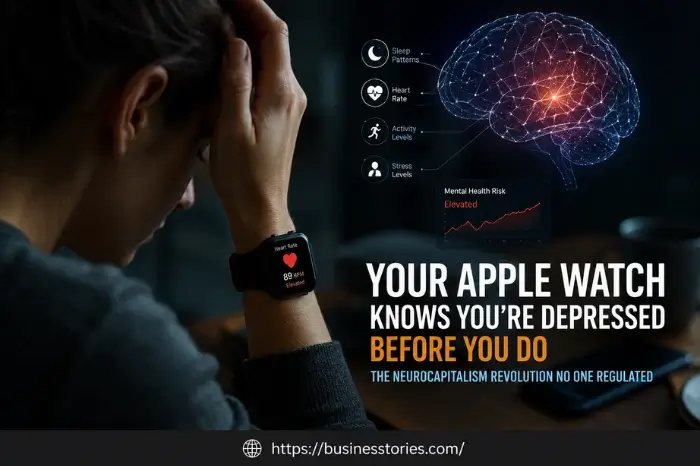
Imagine waking up one morning, and before you even feel sad, your Apple Watch already knows. It notices that your heart rate stayed a little higher overnight. And it observes that you have reduced your physical activity. It detects that you have not replied to messages as quickly. And it quietly feeds all of that data into an algorithm that concludes, “You are sliding toward depression.” This is not science fiction. It is happening right now. And it forms the foundation of something much bigger, a shift so profound that experts now call it the Neurocapitalism Revolution.
In simple terms, neurocapitalism means turning human brain and nervous system data into money. Your thoughts, your moods, and your emotions—they all become commodities. Companies like Apple, Google, and a wave of mental-health startups collect this data from your wearables. They analyze it. They sell insights from it. And most of the time, they do it without any clear rules or oversight.
So, here is the unsettling question at the heart of this article: What happens when technology knows our innermost feelings before we do, and who gets to profit from that knowledge?
In this guide, we will explore how your smartwatch detects depression, what the Neurocapitalism Revolution means for you, where regulation stands, and how you can protect yourself. Let us dive in.
What Is the Neurocapitalism Revolution?
The Neurocapitalism Revolution describes a new economic system where brain data, your emotions, cognitive patterns, and mental states become a valuable asset that companies buy, sell, and trade.
In the industrial revolution, factories transformed raw materials into products. In the data revolution, companies like Facebook turned your clicks and likes into advertising gold. Now, in the neurocapitalism era, corporations turn your inner life, your stress levels, your sleep quality, and your emotional patterns into a revenue stream.
According to research published in Nature Digital Medicine in 2023, wearable devices can now detect physiological markers linked to depression with up to 84% accuracy. That means your Apple Watch does not just track steps. It tracks your soul, or at least the version of your soul that can be measured, quantified, and sold.
How Did We Get Here So Fast?
Three forces came together to create this moment.
- First, wearable technology became cheap and widespread. Over 100 million Apple Watches have been sold worldwide as of 2024, according to industry reports.
- Second, artificial intelligence advanced rapidly, enabling computers to spot patterns in heart rate variability (HRV), skin temperature, and movement that humans could never detect.
- Third, the COVID-19 pandemic triggered a worldwide mental health crisis, significantly increasing the demand for all solutions, including digital ones.
Venture capital poured in. Between 2020 and 2024, investors put more than $5 billion into digital mental-health startups, according to data from CB Insights. Many of these companies built their business models on one simple premise: your emotional data is free for the taking.
The Unique Insight
Here is something most reporters overlook: the Neurocapitalism Revolution does not require your consent to work. Even if you never download a mental-health app, your Apple Watch gathers enough data that a third party could infer your emotional state. Researchers at Stanford University demonstrated this phenomenon in 2022.
They showed that step count, sleep fragmentation, and heart rate alone—the data the watch collects by default—could predict depressive episodes. You never opted into a mental-health screening. But you got one anyway.
How Your Apple Watch Detects Depression Before You Notice It
Let us get specific. Your Apple Watch does not contain a specific sensor for detecting depression. It detects depression indirectly by watching for subtle changes in your body that correlate with mental-health decline.
The Key Biomarkers Your Watch Tracks
Heart rate variability (HRV) serves as the most powerful signal. When HRV drops and stays low, meaning your heartbeat becomes unusually steady. Your nervous system may be stuck in fight-or-flight mode. Researchers at the University of California, San Francisco, found that low HRV predicts major depressive disorder more reliably than standard questionnaires do.
Sleep architecture changes also tell a story. Your Apple Watch tracks how long you spend in deep sleep versus REM. Depressed people often show reduced deep sleep and fragmented sleep patterns. Waking up many times during the night without remembering it is another sign. The watch sees those micro-awakenings clearly.
Activity decline is another flag. When you start moving less, taking fewer steps, taking shorter walks, and spending less time standing, the watch notices. A 2024 study in JAMA Psychiatry found that a 25% drop in daily step count over two weeks correlated strongly with emerging depressive episodes.
Finally, social engagement can be inferred. Apple’s system tracks how quickly you respond to messages. How often you initiate conversations and whether your communication patterns change. Reduced social interaction is a classic depression symptom, and your watch quantifies it.
Real-World Examples Already in Action
In late 2023, Apple filed a patent titled ‘Detecting Mental Health Conditions Using Wearable Data.‘ The patent describes algorithms that combine all the biomarkers above into a single depression risk score. Meanwhile, a company called Mindstrong, which shut down in 2023, used smartphone interaction data (typing speed, scrolling patterns) to detect mood changes.
And Biogen, the pharmaceutical giant, partnered with Apple in 2021 specifically to study how Apple Watch data might identify cognitive decline and depression early. The technology works. The question is, who controls it, and what happens to the data?
Who Profits from Your Brain Data in the Neurocapitalism Revolution?
This is where the Neurocapitalism Revolution gets uncomfortable. When your Apple Watch detects that you might be depressed, it does not keep that insight to itself. It flows into an ecosystem of buyers, sellers, and middlemen.
The Data Brokers You Have Never Heard Of
Most people do not realize that data brokers—companies whose entire business is buying and selling personal information—now include mental-health inferences in their profiles. Companies like Acxiom and Oracle Data Cloud maintain dossiers on billions of individuals. A 2023 investigation by The Markup revealed that some health data marketplaces sell depression propensity scores to advertisers, insurers, and employers.
Let that sink in. Your employer could purchase a dataset that flags employees whose wearable data suggests a high risk of depression. Your health insurer could adjust your premiums based on your Apple Watch HRV readings. None of this is hypothetical — the Washington Post reported in 2022 that UnitedHealth Group had explored exactly these kinds of wearable-data integrations.
The Pharmaceutical Angle
Pharma companies represent another layer. If a drug company knows you’re likely to get depressed before you do, it can target you with ads for antidepressants when you’re most vulnerable. Companies like Johnson & Johnson are already developing predictive marketing and behavioral targeting patents.
The Wellness-App Middlemen
Then there are the apps. Calm, Headspace, BetterHelp, and dozens of others have access to Apple Health data if you grant permission, which millions of users do without reading the fine print. These apps use your biometric data to personalize their offerings, but their privacy policies often allow them to share de-identified data with research partners and advertisers.
Researchers at the University of Oxford demonstrated in 2023 that so-called de-identified health data can be re-identified with frightening ease using just a few data points.
The Regulatory Black Hole: Why No One Is Watching
You might assume that such sensitive data would be tightly regulated. You would be wrong. The Neurocapitalism Revolution has raced ahead of the law by at least a decade.
HIPAA Does Not Protect You Here
Here is a harsh truth: HIPAA, the main U.S. health-privacy law, only covers certain healthcare providers, insurers, and their business associates. It does not cover Apple, Google, Fitbit, or any wellness app you voluntarily give data to. When you share your heart rate with a meditation app, you lose HIPAA protection. The app’s privacy policy, which you probably clicked through in three seconds, governs everything.
The GDPR Gap
Europe’s GDPR offers stronger protections. It classifies health data as a special category of data requiring explicit consent. However, GDPR applies to identifiable data. If a company de-identifies your depression score, something the Oxford research showed to be reversible, the strongest GDPR protections may not apply. Moreover, GDPR enforcement against big tech companies has been slow, with cases taking years to resolve.
The United States Has Nothing Specific.
As of 2025, the United States has no federal law specifically regulating the collection, sale, or use of mental-health inferences from wearable devices. A few states have taken action—California’s Consumer Privacy Act gives residents the right to know what data companies hold and to request deletion—but these state laws are inconsistent and difficult to enforce.
Washington state’s My Health My Data Act, passed in 2023, is one of the strongest, but it explicitly exempts data governed by HIPAA, creating a confusing patchwork.
The Unique Perspective: Regulation May Come from an Unexpected Place
Here is what most analysts miss. The strongest push for regulation might come not from consumer advocates but from insurers. Why? If wearable data were unreliable or manipulated, such as people taking extra steps to avoid triggering a depression flag, insurers could make poor decisions and incur financial losses.
The insurance industry’s lobbying power could drive standardization and oversight that consumer groups have failed to achieve.
The Dark Side of Predictive Mental-Health Technology
Even if you accept that your data might be sold, there is a deeper problem. What happens when the prediction itself causes harm?
Self-Fulfilling Prophecies
Psychologists have long warned about the nocebo effect, the idea that labeling someone as sick can actually make them sicker. If your Apple Watch says you’re likely depressed, you might act depressed even if you weren’t. A 2023 study in The Lancet Digital Health raised concerns that mental-health predictions could create self-fulfilling prophecies, especially among adolescents and young adults.
Discrimination at Scale
Employment discrimination is another risk. The Americans with Disabilities Act prohibits discrimination based on mental health conditions. But what if a company never officially knows you are depressed—they just use a third-party algorithm that recommends not hiring people whose wellness scores fall below a certain threshold? This practice is algorithmic discrimination, and proving it in court is almost impossible.
The Surveillance Effect
Finally, there is a chilling effect. When people know that someone is monitoring their emotional state, they change their behavior. They mask their true feelings. They become performers of their wellness. Mental health advocates argue that such behavior goes against everything we know about psychological healing, which requires authenticity, vulnerability, and safe spaces—not constant surveillance.
How to Protect Yourself During the Neurocapitalism Revolution
You do not need to throw away your Apple Watch. But you do need to take deliberate steps to protect your emotional privacy. Here are six actionable steps.
1. Audit Your Health Data Sharing Settings
Go to the Apple Health app, tap your profile picture, and review every app listed under “Apps.” Revoke access for any app that does not absolutely need your heart rate, sleep, or activity data. Be ruthless. If you have not used a wellness app in a month, cut its access.
2. Read Privacy Policies—Specifically the Partners Section.
When you use a mental-health or wellness app, look at its privacy policy. Skim to the section about third-party sharing. If it mentions de-identified data sharing with research partners or aggregated insights for business purposes, understand that your emotional data may be sold.
3. Use the Sign in with Apple option and hide your email.
Apple’s privacy features, ironically, are among the best tools for fighting the Neurocapitalism Revolution. Use Sign in with Apple and choose Hide My Email so apps do not get your real email address. This reduces linkability between your emotional data and your identity.
4. Consider Turning Off Background Heart Rate Tracking for Non-Essential Apps
Within Apple Health, you can control which apps read your heart rate data in the background. Many wellness apps default to continuous heart rate monitoring even when you are not using them. Turn the feature off unless it is medically necessary.
5. Support Digital Privacy Legislation
Individual action matters, but systemic change requires law. Support organizations like the Electronic Frontier Foundation (EFF) and the Center for Digital Democracy that advocate for neuro-data privacy legislation. Write to your representatives. Consumer choices alone will not tame the Neurocapitalism Revolution.
6. Practice Regular Digital Wellness Check-Ins
Once a month, spend 15 minutes reviewing your privacy settings across all devices and apps. Set a calendar reminder. Technology companies count on you to forget. Consistent, small actions build a strong privacy practice over time.
Where the Neurocapitalism Revolution Is Heading Next
We are only at the beginning. The Neurocapitalism Revolution will accelerate as technology improves.
Brain-Computer Interfaces Are Coming
Apple has filed patents for AirPods that measure brain activity through the ear canal. Neuralink and other brain-computer interface companies are developing direct neural sensors. When these technologies become available to consumers, and they will, the distinction between thought and data will become increasingly blurred. Regulating mood inferences from heart rate will seem quaint compared to regulating direct neural readings.
The Rise of Neuro-Insurance
Expect insurance companies to offer discounts for continuous mental-health monitoring, just as they already offer discounts for fitness tracking. They may say, “Let us watch your brain, and we will cut your premium by 20 percent.” It sounds dystopian, but behavioral economics research from the University of Pennsylvania suggests many consumers will accept such deals, especially as healthcare costs rise.
The Pushback Is Growing
Here is the hopeful part. Awareness is rising. Organizations like the Neurorights Foundation, founded by neuroscientist Rafael Yuste at Columbia University, are pushing for international recognition of neurorights. This idea is that your neural data deserves the same protections as your physical body. Chile became the first country to enshrine neurorights in its constitution in 2021. Colorado passed a neurorights law in 2024. The movement is small but gaining momentum.
Conclusion: Your Mind Is Not a Commodity
The Neurocapitalism Revolution changes everything about how we think about privacy, health, and personal freedom. Your Apple Watch can detect depression before you feel it. That is a wonderful technological achievement and a terrifying one, too.
The central problem is not the technology itself. Early detection of mental-health issues could genuinely save lives. The problem is that this technology was deployed without rules, without consent, and without public understanding. Your emotional data generates profits for companies, yet you lack control over its usage, visibility, and the decisions made based on it.
You can take action. Audit your health data settings. Read privacy policies. Support organizations fighting for neural privacy rights. Talk to friends and family about the neurocapitalism revolution. Awareness is the first step toward change.
Your mind belongs to you. Do not let anyone convince you it is just another product to be bought and sold.
Frequently Asked Questions:
Can my Apple Watch truly detect depression before I become aware of it?
Yes. Your Apple Watch can detect depression by tracking heart rate variability, sleep changes, and activity decline. Nature Digital Medicine found that it could detect these early warning signs with up to 84% accuracy, often before people notice mood changes.
Who owns the mental health data my wearable device collects?
App privacy policies determine what you do legally. Apple has strong privacy protections, but third-party apps you share data with have rules. Many sell de-identified data to data brokers, advertisers, and research partners without your consent.
Does HIPAA protect my Apple Watch mental health information?
HIPAA does not cover Apple Watch data. HIPAA only covers healthcare providers, insurers, and business associates. Wellness apps, data brokers, and tech companies that analyze emotional data are exempt from HIPAA.
How can I stop companies from selling my emotional data?
Start by reviewing your Apple Health sharing settings and removing unnecessary apps. Apple Sign In with a hidden email. Read privacy policies before granting data access. Support the Neurorights Foundation in advocating for laws protecting neural and emotional data from commercial use.
What does the neurocapitalism revolution mean for mental health privacy’s future?
The Neurocapitalism Revolution implies commodifying thoughts, moods, and emotions. Unregulated companies will sell brain data. Increased awareness and neurorights laws in Chile and Colorado offer hope for privacy protections.

Senior Business Analyst / Prduct Owner with 12+ years of experience driving data-driven insights, optimizing business processes, and delivering strategic IT solutions.