Introduction: The Identity Crisis Nobody Is Talking About
Picture this. You hand over your passport at a hotel check-in counter. The clerk scans it. Within seconds, your full name, date of birth, passport number, and biometric photograph travel through at least three backend systems. Now envision a post-quantum computer harvesting, quietly storing, and decrypting all that data five years from now. That is not science fiction. It is the harvest-now-decrypt-later threat, and it is already happening.
Every time you complete a Know Your Customer (KYC) check, whether for a crypto exchange, a bank, or a travel booking, you create a permanent digital fingerprint. Current encryption protects that data for now.
However, quantum computers are expected to reach cryptographically relevant scale by 2030. They will shred through today’s RSA and ECC encryption like paper. When that happens, every passport scan ever collected will effectively become public.
This article explains why post-quantum zero-knowledge KYC (ZK-KYC) is the only identity architecture to survive the quantum era. You’ll discover how the technology operates. Its significance for your privacy. The necessary actions that governments and businesses must take before the opportunity expires.
1. Understanding the Passport Leak Problem
How Your Passport Data Gets Exposed Today
Modern passports contain an NFC chip that stores your personal data, including your facial biometrics. When a border agent or hotel clerk taps that chip, the data flows through middleware, cloud verification services, and third-party databases. Each hop creates a copy.
According to a 2025 report by the Identity Theft Resource Centre, over 3,200 data breaches occurred in the United States alone, exposing well over 350 million records. Travel and hospitality ranked among the top five most-targeted sectors.
The real danger is not just the breach itself. It is the aggregation of identity fragments over time. A hacker who collects your passport number from one breach and your facial scan from another can reconstruct your complete identity profile.
That profile then enables synthetic identity fraud, account takeovers, and even physical passport cloning. Europol estimates that identity fraud costs the European Union approximately €1.8 billion annually, with passport forgery accounting for a significant share.
The Harvest-Now-Decrypt-Later Threat Explained
Harvest-now-decrypt-later (HNDL) works exactly as it sounds. Adversaries, including nation-states and organized crime groups, intercept and store encrypted data today. They do not need to decrypt it immediately. Instead, they simply wait until quantum computers become powerful enough to break the encryption.
Because passport data has a lifetime value (your face and fingerprint never expire), stolen encrypted identity records retain their worth indefinitely. The U.S. National Institute of Standards and Technology (NIST) has been clear about the timeline.
In its 2024 post-quantum cryptography standardization announcement, NIST urged organizations to begin migration immediately, noting that the transition could take a decade or more. The message is simple: if you are not post-quantum ready by 2030, your encrypted data is already compromised.
A unique insight rarely discussed is that passport data is particularly vulnerable because it sits at the intersection of government-issued identity and commercial verification. Governments control the issuance but rarely the verification chain.
Every hotel, bank, and exchange that scans your passport becomes a potential leak vector. This fragmented responsibility creates a security gap that quantum attackers will exploit systematically.
2. The Quantum Threat Timeline: Why 2030 Is the Deadline
Where Quantum Computing Stands Today
IBM crossed the 1,000-qubit threshold with its Condor processor in late 2023. In 2025, the company announced its quantum roadmap targeting a 100,000-qubit system by 2033. Meanwhile, Google Quantum AI demonstrated a logical qubit with below-threshold error rates in 2024, proving that fault-tolerant quantum computing is achievable. The pace of progress is not linear. It is accelerating.
Shor’s algorithm, developed in 1994, provides the mathematical framework for breaking RSA encryption on a sufficiently large quantum computer. The only missing ingredient has been hardware capable of running it at scale.
Estimates published by the Global Risk Institute suggest a 50% probability that quantum computers will break RSA-2048 within 15 years of 2022. This places the danger zone squarely between 2030 and 2037. More aggressive forecasts from MIT and IBM shorten that window considerably.
Why Migration Cannot Wait
The migration to post-quantum cryptography is not like a software update. It requires replacing cryptographic primitives embedded deep inside hardware, protocols, and legal frameworks. The European Telecommunications Standards Institute (ETSI) has warned that the full migration could take 10 to 15 years.
Starting in 2030 means finishing in 2040 at best, long after quantum computers have rendered current systems obsolete. Consider the scale. There are approximately 1.5 billion e-passports in circulation globally, each containing cryptographic keys that secure the chip-to-reader communication. Replacing or upgrading every single one requires coordinated international effort.
The International Civil Aviation Organization (ICAO), which sets passport standards, began working on quantum-resistant specifications only in 2023. The gap between standardization and deployment is measured in years, not months.
Here is a perspective to not miss: the quantum threat to identity is not just about breaking encryption. It is about breaking trust in the entire concept of digital identity. If anyone with a quantum computer can forge a cryptographically valid passport, the distinction between real and fake disappears.
Border security reverts to visual inspection, and visual inspection fails against sophisticated forgeries roughly 40% of the time, according to INTERPOL test data.
3. What Is Zero-Knowledge KYC and Why It Changes Everything
The Core Concept: Prove Without Revealing
Zero-knowledge proofs (ZKPs) allow one party to prove to another that a statement is true without revealing any information beyond the validity of the statement itself. Applied to KYC, this technology means you can prove you are over 18 without disclosing your exact birth date.
You can prove you are a citizen of a specific country without revealing your passport number. Moreover, you can prove you are not on a sanctions list without exposing your full identity to every verifier.
In simple terms, ZK-KYC uses special math methods like zk-SNARKs or zk-STARKs to create a proof that a verifier can check against a public source. The verifier learns only whether the proof is valid. They never see the underlying data. This reverses the conventional KYC model.
ZK-KYC vs. Traditional KYC: A Side-by-Side Comparison
Traditional KYC works like showing your entire wallet to prove you carry a driver’s license. You hand over documents; the verifier copies and stores them. Each new verifier creates another copy. Your identity spreads across dozens or hundreds of databases. Each one is a potential breach point.
ZK-KYC, by contrast, works like showing a holographic badge that confirms “approved” without displaying any personal details. The verifier receives cryptographic assurance, not personal data.
The privacy gains are dramatic. A 2025 pilot by the European Commission’s EU Digital Identity Wallet demonstrated ZK-KYC for age verification across five member states. Users proved eligibility for age-restricted services without revealing their birth date or name.
The pilot reported a 92% user satisfaction rate and zero data breaches associated with the verification process. Compare that to the traditional approach, where each verification creates a permanent, copyable record.
What makes ZK-KYC truly transformative is the elimination of centralized honeypots. Under the current model, a single breach at a large KYC provider exposes millions of identity records. Even if an attacker compromises the verifier’s server, only cryptographic proofs will be found. Mathematical objects that cannot be reverse-engineered to reveal identity data. There is simply nothing to steal.
4. Why Post-Quantum Cryptography Is the Missing Layer
ZKPs Alone Are Not Enough
Here is a critical point that many articles miss. Zero-knowledge proofs provide privacy-preserving verification. However, the cryptographic foundations of most ZKP systems today rely on elliptic curve pairings or discrete logarithm assumptions.
These mathematical problems are the same ones that Shor’s algorithm can solve on a quantum computer. In other words, a quantum attacker could forge ZK proofs and impersonate anyone they choose.
A post-quantum zero-knowledge KYC solution uses new types of cryptography, such as lattice-based, hash-based, or code-based methods, that can withstand attacks by quantum computers. NIST has standardized several such algorithms. That includes CRYSTALS-Kyber for key encapsulation and CRYSTALS-Dilithium for digital signatures. Newer proposals like HAWK and SQISign specifically target post-quantum zero-knowledge proof systems.
How Post-Quantum ZK-KYC Works in Practice
The architecture combines three layers. First, a post-quantum signature scheme authenticates the identity issuer (for example, the passport authority). Second, a post-quantum zero-knowledge circuit generates the privacy-preserving proof. Third, a post-quantum verification algorithm checks the proof without accessing the original data. Every link in the chain resists quantum attack, ensuring end-to-end security.
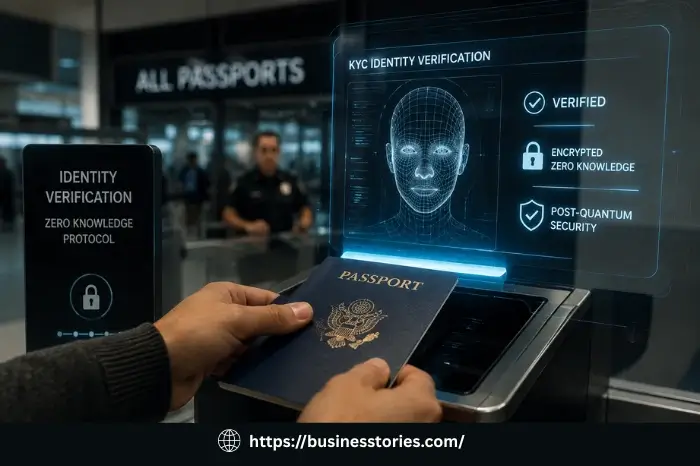
In practical terms, here is how a post-quantum ZK-KYC identity verification would work at a hotel in 2030. You tap your quantum-resistant digital identity card. The hotel’s system receives a ZK proof confirming that you are a verified traveler with a valid passport from an accepted country. The proof also confirms you are not on any watchlist. The hotel never sees your name, passport number, or photo.
They receive cryptographic certainty without any personal data. Even if a quantum computer later attacks the hotel’s records, it finds only lattice-based proofs that remain secure.
The financial sector is already moving. The Bank for International Settlements (BIS) Project Tourbillon, completed in 2024, explored post-quantum privacy for central bank digital currencies using zero-knowledge proofs. Their findings showed that quantum-safe ZKPs can achieve both regulatory compliance and user privacy at the same time, which are usually considered conflicting goals.
5. Real-World Deployment: Who Is Building Post-Quantum ZK-KYC?
Government and Institutional Initiatives
The European Union is at the forefront with its eIDAS 2.0 regulation, which requires all member states to adopt the EU Digital Identity Wallet by 2026. While the current rules don’t require full readiness for post-quantum security, the technical groups have recommended that member states choose algorithms that can resist quantum threats for their national systems.
France, Germany, and the Netherlands have each launched post-quantum migration task forces specifically for digital identity infrastructure.
In Asia, Singapore’s National Digital Identity (NDI) program has begun researching quantum-safe ZKPs for its SingPass and CorpPass systems. The Government Technology Agency (GovTech) published a 2025 whitepaper outlining a phased approach.
By 2028, the program expects to have quantum-resistant signatures, and by 2032, it anticipates full post-quantum ZK-KYC. South Korea’s Digital Identity Alliance, a consortium of banks and telecom providers, has followed a similar roadmap.
Private Sector and Blockchain Integration
Blockchain-based identity projects have been among the earliest adopters. Polygon’s Polygon ID uses ZK proofs for on-chain KYC, and the team announced post-quantum research initiatives in 2025. zkSync and StarkWare, two major Ethereum scaling solutions, have both committed resources to post-quantum ZK circuits, recognizing that Layer 2 security depends on long-term cryptographic robustness.
A fascinating case comes from the travel industry. SITA, the air transport IT provider serving over 400 airlines, announced in 2025 a partnership with a cryptographic research lab to develop quantum-resistant digital travel credentials. Their prototype allows passengers to generate a ZK proof of valid travel authorization directly on their phone, with the airline receiving only a yes/no verification. The system eliminates passport data exposure across the entire airline check-in chain.
What makes these deployments noteworthy is the shift from theoretical research to production engineering. Five years ago, post-quantum ZK-KYC was a conference paper topic. Today, it is a funded, staffed, and scheduled engineering effort at some of the world’s largest identity providers. The question is no longer whether the technology works, but whether deployment can outpace the quantum threat clock.
6. Actionable Steps: How to Protect Your Digital Identity Now
For Individuals
You cannot control when governments adopt post-quantum standards, but you can reduce your identity attack surface today. Start by auditing where your passport data has been stored. Cancel old accounts on platforms you no longer use. Request data deletion under GDPR or CCPA where applicable. Every stored copy of your passport is a future quantum target.
Use decentralized identity solutions where available. The W3C Verifiable Credentials standard, now supported by major platforms including Microsoft and IBM, lets you hold cryptographically signed credentials on your device. When paired with ZK proofs, these credentials enable selective disclosure, sharing only the specific claim a verifier needs. You share “born before 2005” rather than your full birth certificate.
Stay informed about quantum-safe product timelines. When your bank, exchange, or government portal announces a security upgrade, look specifically for mentions of NIST post-quantum standards (CRYSTALS-Kyber, CRYSTALS-Dilithium, FALCON, or SPHINCS+). If they are upgrading to post-quantum cryptography, they are protecting your data against the harvest-now-decrypt-later threat. If not, ask why.
For Organizations
Conduct a cryptographic inventory immediately. Identify every system that processes, stores, or transmits identity data. For each system, document the cryptographic algorithms in use and their quantum vulnerability status. NIST provides a free Cryptographic Inventory Tool to help organizations perform this assessment. You can only protect what you know you have.
Begin a phased migration to post-quantum KYC infrastructure. Start with hybrid schemes that combine classical and post-quantum algorithms, providing defense in depth during the transition. The European Union Agency for Cybersecurity (ENISA) recommends targeting high-value identity systems first: national ID databases, passport issuance systems, and large-scale KYC providers serving financial institutions.
Engage with the ZK-KYC vendor ecosystem. Companies including QEDIT, ING’s Zero-Knowledge Set Membership team, and Privado ID offer privacy-preserving identity verification tools. Evaluate their quantum readiness roadmaps. Insist on open standards and interoperability. The worst outcome is adopting a proprietary ZK-KYC solution that locks you into quantum-vulnerable cryptography.
7. The Future of Identity: Beyond 2030
Self-Sovereign Identity Meets Quantum Safety
The convergence of self-sovereign identity (SSI) and post-quantum cryptography points to a radically different future. In this model, you hold your identity credentials on your device. You generate ZK proofs locally. You share those proofs, never raw data, with verifiers. The entire chain, from credential issuance to proof verification, uses quantum-resistant algorithms. Your passport data never leaves your control.
This model could fundamentally reshape industries. Airlines would never store passenger passport scans. Banks would never hold customer identity documents. Hotels would never keep copies of guest IDs. The entire concept of a “data breach involving identity documents” would become obsolete because there would be no centralized identity documents to breach.
Policy and International Coordination
Technology alone cannot solve the passport leak problem. International coordination is essential. The ICAO must update Doc 9303, the global standard for machine-readable travel documents, to mandate post-quantum cryptography for chip authentication and data protection. The Financial Action Task Force (FATF) must update its digital identity guidance to recognize ZK-KYC as a compliant verification method across jurisdictions.
The encouraging news is that these conversations are already happening. The World Economic Forum’s Digital Identity workstream has published papers on quantum-safe identity architectures. The G7 Digital Ministers’ 2025 communiqué explicitly mentioned post-quantum identity infrastructure as a priority. The machinery of international cooperation, while slow, is turning in the right direction.
A final insight worth emphasizing: post-quantum ZK-KYC does not just solve a technical problem. It solves a governance problem. Today, verifying your identity means trusting dozens of intermediaries, any one of which can fail and expose your data. Post-quantum ZK-KYC replaces that trust with mathematics.
You trust the proof, not the prover. That shift, from institutional trust to cryptographic trust, represents the most profound change in identity architecture since the invention of the passport itself.
Conclusion: The Clock Is Ticking — Act Now
Your passport is leaking. Not today, perhaps, but every scan, every KYC check, and every hotel check-in creates a copy that quantum computers will eventually decrypt. The harvest-now-decrypt-later threat is not hypothetical. It is a ticking clock, and 2030 is the widely recognized deadline by which cryptographically relevant quantum computers are expected to emerge.
Post-quantum ZK-KYC offers the only identity architecture that survives this transition. By combining privacy-preserving zero-knowledge proofs with quantum-resistant cryptographic foundations, it simultaneously protects your personal data from breaches today and quantum attacks tomorrow. No other approach addresses both dimensions of the threat.
The technology exists. The standards are published. Early deployments are underway in Europe, Asia, and the private sector. What remains is the will to migrate, and migration takes years, not months. Every organization that delays its post-quantum KYC transition increases the risk of exposing its users’ identity data.
Your next step is simple but urgent. If you are an individual, demand quantum-safe identity solutions from the services you use. If you are an organization, begin your cryptographic inventory and migration planning this quarter. The quantum future is not coming. It is already here. The only question is whether your identity architecture will be ready for it.
Frequently Asked Questions
Q1: What makes post-quantum ZK-KYC different from regular KYC?
Post-quantum ZK-KYC uses quantum-resistant zero-knowledge proofs to verify your identity without seeing or storing your passport data, eliminating centralized data honeypots.
Q2: When will quantum computers realistically break passport encryption?
Between 2030 and 2037, experts expect cryptographically relevant quantum computers. However, the harvest-now-decrypt-later threat puts stolen data at risk of quantum decryption.
Q3: Which post-quantum algorithms does NIST recommend for identity systems?
NIST has standardized CRYSTALS-Kyber for key encapsulation, CRYSTALS-Dilithium and FALCON for digital signatures, and SPHINCS+ for stateless hash backup. These four underpin post-quantum identity security.
Q4: Can zero-knowledge proofs actually resist quantum computer attacks successfully?
Only post-quantum primitives, such as lattice-based or hash-based constructions, can achieve this level of security. Standard elliptic curve ZKPs are vulnerable. The HAWK and SQISign proposals target quantum-safe ZK proof systems for digital identity.
Q5: How can I prepare my personal digital identity for the post-quantum migration?
Audit passport data storage, delete unused platforms, use decentralized identity wallets with W3C Verifiable Credentials, and choose services with NIST post-quantum security roadmaps.

Senior Business Analyst / Prduct Owner with 12+ years of experience driving data-driven insights, optimizing business processes, and delivering strategic IT solutions.