
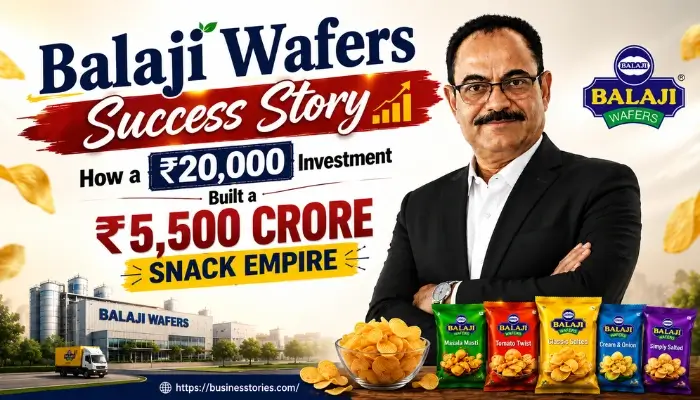
Every big brand starts with a small story. For Balaji Wafers, that story began in a cinema hall canteen in Rajkot. Three brothers had lost all their money. They had no plan and no backup. Yet today, their brand holds 90% of the chips market in Gujarat. Moreover, it has beaten PepsiCo, one of the world’s biggest food giants, in large parts of Western India. The Balaji Wafers success story is not just a business tale.
It is a story of family, faith, and pure hard work. So let’s dive in and discover how three brothers turned ₹20,000 into a ₹5,500 crore snack empire.
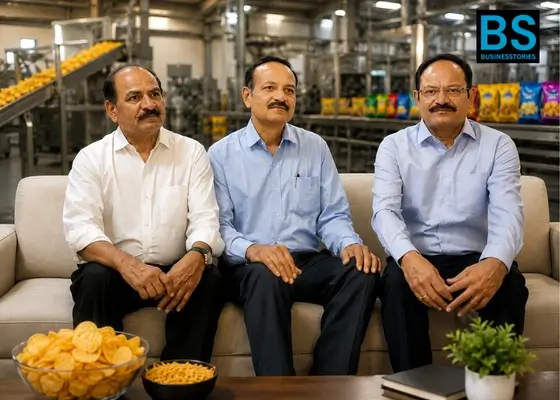
Who Founded Balaji Wafers? Meet the Virani Brothers
A Family That Refused to Quit
The story begins in the early 1970s. The Virani family lived in a small village in Gujarat’s Jamnagar district. They were farmers. However, a severe drought hit the region. Crops failed. Income dried up. Life became very hard.
So their father, Popatbhai Virani, took a big step. He sold his ancestral farmland. Then he gave his three sons, Chandubhai, Bhikhubhai, and Kanubhai, ₹20,000 to start fresh in the city.
From One Failure to the Next
The brothers moved to Rajkot with high hopes. First, they put all their money into a fertilizer and farm equipment business. But a dishonest trader tricked them with fake goods. Within two years, they lost every rupee.
Most people stop after a loss like that. But the Virani brothers kept going. Instead of giving up, they took small daily jobs to survive. Then, one day, they got a chance to manage a snack stall at a local cinema hall. They worked hard. The cinema owner noticed. Soon, they ran the full canteen.
It was here that Chandubhai started frying potato wafers by hand. Customers loved them right away. Demand grew fast. And just like that, without planning it, a snack empire had begun.
Key Lesson: Every setback can point you to a new path. The brothers lost their first business. But that loss led them straight to Balaji Wafers.
How Balaji Wafers Got Started Officially
Growing Out of the Kitchen
Throughout the 1970s and 1980s, the Virani brothers sold their hand-made wafers across Rajkot. They packed them in small bags. Then they delivered them on bicycles to local shops. Word spread fast. By the late 1980s, they could not keep up with demand from their home kitchen.
In 1989, Chandubhai made a daring move. He set up Balaji’s first real factory. The total cost was ₹50 lakh, a mix of savings and a bank loan. At that time, it was the biggest potato wafer plant in all of Gujarat.
The Name and the Faith Behind It
Then, in 1992, the brothers officially registered the company as Balaji Wafers Private Limited. They chose the name “Balaji,” another name for Lord Hanuman, after a small idol they kept at home. For them, faith was not separate from business. It was part of everything they did.
Gujarat’s First Fully Mechanised Factory
By 1999, Balaji had built Gujarat’s first fully mechanized potato chips factory. This was a huge move. Where Chandubhai once cut potatoes by hand, machines now process thousands of kilograms every day. As a result, quality stayed consistent. Costs came down. And the brand could finally serve a much bigger market.
Unique Insight: When new machines broke down, engineers could not fix them. So Chandubhai studied the machines himself and repaired them on his own. That kind of self-reliance became a key part of Balaji’s culture.
Balaji Wafers’ Business Strategy: One Area at a Time
Most companies rush to cover the whole country at once. Balaji did the opposite. Their core strategy was simple: “One area at a time, one fight at a time.” This focus helped them build strong roots instead of spreading too thin.
Local Flavours for Local People
Rather than offering the same taste everywhere, Balaji studied what each region loved. For example, they made spicier snacks for Rajasthan. They created Gathiya-style products for Gujarat. They introduced a Chaat Chaska flavour specifically for Maharashtra.
This local approach gave them a big edge. Global brands like Lay’s offered standard flavours everywhere. Balaji, however, spoke directly to each region’s taste. As a result, local buyers felt the brand truly understood them.
Prices That Everyone Could Afford
Balaji sold snacks for as little as ₹5 per pouch. But this was not just a price cut. It was a clear message: outstanding taste does not need to cost a lot. Their tagline, “Kam Hawa, Wafers Zyaada” (Less Air, More Wafers), hit a nerve. People were tired of paying for mostly air in a snack bag. So, Balaji offered a larger quantity of product for the same price.
Customers noticed immediately. Furthermore, this strategy worked especially well in smaller towns and villages.
A Distribution Network Built on Relationships
Balaji built a network of over 800 distributors. They reached 4 to 5 lakh retail stores across western India. What’s more, Chandubhai has said that 80% of their raw material suppliers are local farmers. So their supply chain directly helped Indian farming communities. In turn, this relationship built deep trust on both sides, with suppliers and with customers.
The PepsiCo Moment: When Balaji Said No to Billions
This episode is perhaps the most powerful chapter in the Balaji Wafers success story.
Around 2014, PepsiCo, the owner of Lay’s and Kurkure, reportedly offered to buy Balaji Wafers. The offer was huge. It was said to be about four times Balaji’s revenue at the time. In simple terms, PepsiCo offered several thousand crores.
Chandubhai said no.
Why He Walked Away
His actions shocked the business world. After all, that kind of money could set up a family for generations. Yet Chandubhai’s reason was clear. He had not built Balaji to sell it. He built it for his workers, his farmers, his family, and his community. Selling would mean giving up control of the flavours, the prices, and the culture he had built over 30 years.
So he walked away. Ultimately, this decision was the correct one.
The Payoff Was Huge
By staying independent, Balaji continued to grow steadily. Today, the brand commands a 60% to 90% market share in wafers across Gujarat, Maharashtra, Madhya Pradesh, and Rajasthan. That is far ahead of any global competitor.
Moreover, fast forward to 2025, PepsiCo wants back in. This time, so do ITC, KKR, Carlyle, and Temasek. They are all competing to buy just a 10% stake in Balaji at a valuation of ₹40,000 crore. That is the reward for saying no at the right time.
Product Range: Balaji Offers Much More Than Just Potato Chips
Many people only know Balaji for its potato chips. But in fact, the brand has built a wide range of snacks over the years.
Today, Balaji offers over 50 products across three key areas:
- Potato Wafers — their core product, available in salted, masala, and regional flavours.
- Namkeen — including Gathiya, Sev, and a mix of traditional Indian snacks.
- Grain-Based Snacks — including extruded snacks, noodles, and confectionery items
Their daily output is remarkable. The company makes 1,000 quintals of potato wafers and 5,000 quintals of savouries every single day. They run four factories in Rajkot, Valsad, Lucknow, and Indore. Therefore, they now operate on a national scale.
In addition, Balaji has expanded its reach to include exports to the UAE, Australia, the UK, and the USA. A brand that started in a small canteen now feeds Indian families on five continents.
The Financial Journey: From ₹50,000 to ₹5,500 Crore
| Year | Revenue Milestone |
| 1982 | Annual turnover of approx. ₹50,000 |
| 1989 | First factory set up with ₹50 lakh investment |
| 2006 | Captured 90% of Gujarat’s chips market |
| 2017 | Revenue crossed ₹1,800 crore |
| 2021 | Revenue reached approximately $500 million (₹4,000+ crore) |
| FY2024 | Net sales of ₹5,453.7 crore, up 10.7% year-on-year |
| FY2024 | Profit after tax of ₹578.8 crore, up 41.4% |
Family Values: The Real Secret Ingredient
One of the most touching parts of the Balaji Wafers success story is how the Virani family stayed together. In many Indian family businesses, money and power cause splits. But the Viranis found a different way.
A Philosophy of “Yours, Not Mine”
Chandubhai once compared the family to characters in the Mahabharata and Ramayana. He said that thinking only of “mine” leads to ruin. But thinking of “yours” leads to growth. So the brothers always put the family first, before personal gain.
Even today, the whole family eats lunch together at the factory every afternoon. That simple act keeps them bonded.
The Next Generation Takes Over
The children of the Virani brothers now run different parts of the business. Keyur leads research and development. Mihir heads marketing. Pranay manages construction and business development. Each person has a clear role. So the company runs smoothly across generations.
Also worth noting: women make up almost 50% of Balaji’s workforce. Such parity is rare in Indian manufacturing. Yet Balaji has made it a priority, and it clearly works.
Awards and Recognition: India’s Sultan of Wafers
Over the years, Balaji has earned real respect in the industry. Here are some key highlights:
- The Economic Times named Balaji Group the “Sultan of Wafers.”
- Asia Pacific Food Online featured Balaji Group in an article titled “Chip Off the Old Block.”
- Balaji Group has long been a member of the Snack Food Association of India.
- Euromonitor, a global research firm, tracked Balaji’s steady market share growth from 2013 to 2015, even as Lay’s share fell.
These awards show that the brand’s success goes beyond sales. The whole industry respects what the Viranis have built.
What Every Entrepreneur Can Learn from Balaji Wafers
The Balaji Wafers success story holds clear lessons for anyone who wants to build a business.
- Start with what you have. The brothers started with a canteen stall and fried wafers by hand. They did not wait for a big budget. They just started.
- Learn your customer deeply. Balaji made different flavours for different regions. This local focus beat global brands on their home turf.
- Keep prices fair. Low prices did not hurt Balaji. Instead, they built millions of loyal customers who came back again and again.
- Fix your problems. When machines broke down, Chandubhai fixed them himself. Do not always wait for experts. Learn the work yourself.
- Know when to say no. Rejecting PepsiCo’s billions was the correct decision. Today, the brand is worth ten times more. Patience pays off.
- Put people first. Buying from farmers, paying fair wages, and sharing lunch as a family, these values built a brand that advertising alone cannot replicate.
Conclusion: Balaji Wafers Success Story Shows Homegrown Brands Can Win
The Balaji Wafers success story proves one thing clearly: you do not need foreign money, fancy offices, or big celebrity deals to build a remarkable brand. You need grit, clear values, and the courage to keep going when things get challenging.
Three brothers from a drought-hit village started with ₹20,000 and zero experience. They failed, got cheated, and started over. But they stayed focused. They served their customers well. They treated their workers like family. And step by step, they built a ₹5,500 crore empire that the whole world now wants a piece of.
So next time you open a packet of Balaji Wafers, think about what went into making it. Inside every crispy chip is 50 years of hard work, three brothers’ dreams, and the simple belief that doing good work is always enough.
Did the Balaji Wafers success story inspire you? Share it with someone who needs a push today. For more stories like these, keep reading businesstories.com, where the best business journeys in India come to life.

Tabassum Shaik is an Author, Researcher, and SEO Specialist with over 8 years of experience creating informative content on business, startups, entrepreneurship, marketing, technology, and digital trends. She specializes in researching industry trends and transforming complex topics into practical, easy-to-understand insights. Her goal is to help readers stay informed, learn new ideas, and make better business decisions.