
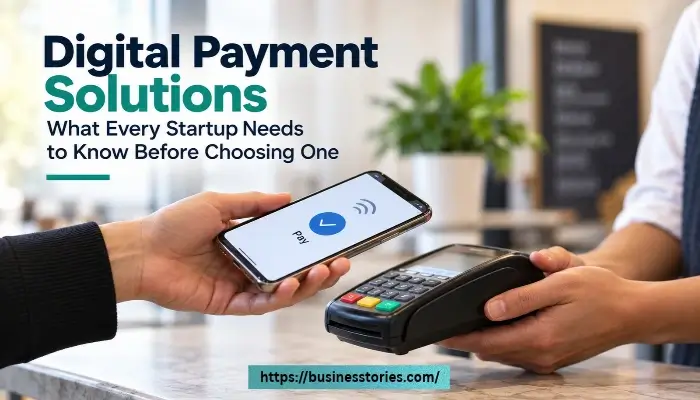
Picking a payment system sounds simple. But once you look closer, things get messy. In fact, you see gateways, processors, wallets, and dozens of pricing plans. They all sound alike at first. Still, this choice matters a lot. The right digital payment solutions can speed up your cash flow.
They can also build trust and support growth. On the other hand, the wrong choice can cost you sales. It can also invite fraud or hidden fees. So this guide explains everything in simple terms.
First, we cover what digital payment solutions are. Then, we explain why they matter for young companies. We also cover security, cost, and common mistakes. By the end, you will also have a clear checklist. You can use it today.
What Are Digital Payment Solutions?
Digital payment solutions are tools. They let a business accept and manage electronic payments. Instead of cash or paper checks, you collect money through cards. You can also use bank transfers or digital wallets.
Furthermore, some newer tools support buy-now-pay-later options. In fact, most digital payment solutions combine a few parts that work together.
Payment gateway.
- First, the payment gateway captures a customer’s card details at checkout.
- Then, it encrypts that data to keep it safe.
- Next comes the payment processor.
- Then, this part moves the data between the customer’s bank and your business bank.
- The funds are ultimately held in a merchant account for a short time.
- Thereafter, the money settles into your business account.
- Furthermore, many providers, like Stripe, Square, and PayPal, bundle all three into one platform. So, founders do not need to piece it together themselves.
For a startup, this bundle is often a relief. So, you can build a working checkout in days, not months. Still, it helps to know each part, because that knowledge leads to smarter choices later. For example, if your processor charges high fees, you can often switch it. Your checkout page can stay the same.
In fact, market numbers back these claims up. Statista projects that the worldwide digital payment transaction value will reach $37.45 trillion in 2026. Furthermore, that number keeps climbing every year.
In fact, this growth shows something simple: customers now expect digital payment options. They see it as normal, not extra. So, a startup that treats payments as an afterthought is fighting that trend, not riding it.
Here is a point many people skip. Your payment stack is also a data source. In fact, every sale carries clues about customer habits and cart drop-off. So, treat your digital payment solutions provider as more than a checkout tool. Instead, consider it an early partner for business insight, too.
Why the Right Choice Matters So Much for Startups
Many founders treat payments as a small detail. But in fact, they sit at the center of your business. They shape both the customer experience and your cash health. So, getting these aspects right early can save you a painful switch later.
Think about cash flow first. Startups frequently operate with narrow profit margins. So, a slow payout schedule can create real stress fast. Some providers release funds the next day. Others, however, hold funds for a week or more.
If payroll depends on that cash, a slow cycle can quietly choke your business. That is why checking settlement speed early is not optional. Furthermore, trust matters just as much. In fact, shoppers often leave a cart when checkout looks unfamiliar or clunky.
On the other hand, a clean, secure-feeling checkout tells first-time buyers your startup is real. Trust is fragile in the early days. So your checkout often does more to win visitors over than your ad copy does.
How to scale it?
Scale matters too. For example, a setup that handles ten orders a day may break at ten thousand. So, your digital payment solutions provider should support rising volume and new currencies without a full rebuild.
Stripe, for example, says it supports over 135 currencies. That flexibility helps if you ever plan to sell abroad. Your payment provider can shape your fundraising story. Specifically, investors often ask about payment costs per sale during due diligence.
A messy or costly setup can raise concerns. But a clean, well-run one signals real operating skill. In other words, a smart choice now can make your next funding talk easier.
Finally, think about repeat business. For example, Amazon uses payment history to offer things like installment plans. Such a strategy, in turn, fosters loyalty over time. Startups rarely have Amazon’s scale.
Still, the lesson holds: smart use of payment data can turn one-time buyers into regulars.
Types of Digital Payment Solutions to Consider
Not every startup needs the same setup. Instead, knowing the main types helps you match a tool to your real business, not just a trend.
Payment Gateways
A payment gateway is the secure link between your checkout page and the banks involved. It encrypts card details and sends them for approval. If you run an online store, you will likely need one. Luckily, most all-in-one platforms already include a gateway.
Digital Wallets
Digital wallets, like Apple Pay, Google Pay, and PayPal, let people pay from a saved account. So, they skip typing in card numbers. This method is booming: wallets made up 53% of global online purchases in 2025.
That is more than double the share for credit cards. So, if your buyers are young or mobile-first, skipping wallets could quietly cost you sales.
Payment Processors and Aggregators
Processors move money between banks behind the scenes. Aggregator-style processors, like Stripe or Square, group many small merchants under one shared account. As a result, onboarding is quick, and paperwork stays light.
This setup suits most early-stage startups well. But as you grow, a dedicated merchant account may offer better rates and more control.
Buy Now, Pay Later and Other Options
Buy-now-pay-later, or BNPL, lets shoppers split a payment into smaller pieces. This market is growing fast: global BNPL revenue should hit $28.44 billion in 2026.
Meanwhile, bank-to-bank transfers are growing quickly outside the United States, especially in Asia. If you plan to sell overseas, it’s important to look into local payment habits, not just card networks.
In the end, most growing startups use a mix. That usually means one core gateway or processor, plus wallet and BNPL support on top. This step-by-step approach tends to serve customers better than chasing one tool that does everything.
Must-Have Features and Security Standards
Once you know the types, you need a simple checklist for comparing providers. A few features matter most.
Integration and Developer Support
Your provider should connect easily with your website or app. It should also work well with tools like Shopify or WooCommerce. Good documentation and quick developer support, in turn, save your small team weeks of extra work.
Fraud Prevention and PCI DSS Compliance
Security should never be an afterthought. Every provider you consider should meet PCI DSS rules. This is the industry standard for keeping card data safe. Beyond that baseline, look for built-in fraud checks and chargeback support.
Otherwise, one disastrous fraud wave can wipe out a young company’s thin profit.
Multi-Currency and Multi-Method Support
Even if you launch in one country, plan anyway. Often, adding new currencies later means rebuilding parts of your checkout. To avoid that pain, choose a flexible provider from day one.
Reporting and Analytics
Finally, look for a dashboard that shows sales trends and failed payments in plain language. As noted earlier, this data can become one of your most useful early business tools. So, do not treat reporting as a small extra.
Understanding the Real Costs of Digital Payment Solutions
Pricing pages often look simple, showing just one flat rate. In reality, though, the full cost of digital payment solutions has several layers. So, startups that skip this step often get a surprise on their first bill.
Transaction fees are the most visible cost. These are usually a percentage plus a small flat fee per sale. However, other charges often apply too. These can include monthly fees, currency fees, and chargeback fees. So, comparing providers by headline rate alone is a common and costly mistake.
Volume also changes your power in this deal. Many processors offer lower rates once your sales grow. So, it is worth simply asking if lower tiers exist. Do not just assume the listed rate is fixed forever. Inquiring early, even as a small startup, establishes a positive precedent for future discussions.
Hidden costs deserve extra care too. Some providers charge for refunds, disputes, or even inactivity. Meanwhile, switching providers later can cost real time and money, especially once your business depends on one. So, reading the full fee list before signing up is far cheaper than switching six months later.
How to Choose the Right Digital Payment Solution: Step by Step
With the background covered, here is a simple path for narrowing your choices.
- Map your business model first: Are you selling goods, subscriptions, or services? This shapes whether you need recurring billing, in-person card readers, or a simple one-time checkout.
- List your must-have features: Pull together the security, integration, and currency needs from above. Then, use that short list to filter providers fast.
- Ask for full pricing details: Request total costs at your expected sales volume, not just the headline percentage.
- Test the checkout yourself: Walk through the buying steps like a real customer would. If it feels slow to you, it will feel worse to a stranger.
- Verify payout speed and support quality: Send a real question to support before you sign up. The response you receive often indicates how they will handle disputes with you in the future.
- Start small, then grow deliberately: Launch with one solid provider, then watch its performance for a few months. Add more tools only once you have clear proof you need them.
These steps will not guarantee a perfect pick. But they replace guesswork with real proof. That is precisely what a young startup team needs.
Common Mistakes Startups Make When Choosing Digital Payment Solutions
Even careful founders can make the same mistakes. Spotting them early, though, can save real money.
The first mistake is chasing the lowest headline rate without checking the full fee list. As noted, hidden fees can easily outweigh a lower advertised rate.
Second, many startups delay fraud prevention, thinking it only matters at a bigger scale. But scammers often target smaller merchants exactly because their defenses are weaker.
Third, some founders ignore customers abroad completely. Later, they learn that missing local payment methods quietly costs them sales in key markets. Some teams create custom tools too soon for flexibility they don’t yet require. This wastes scarce engineering time.
Finally, and perhaps most often, startups skip reading reviews about support and uptime. A provider with frequent outages or slow help can hurt customer trust badly. This principle holds even when its pricing looks excellent on paper.
Conclusion: Choosing Digital Payment Solutions That Grow With You
Choosing among digital payment solutions is not just a technical task. Instead, it shapes your cash flow and your customer trust. It can even shape your fundraising story. As this guide has shown, the right pick depends on a few things.
These include your business model, your growth plans, and how seriously you treat security and clear pricing. In the end, the best digital payment solutions fit where your startup stands today. They also leave room for where you are heading next.
Here is a quick recap.
- First, learn the core parts: gateways, processors, and wallets.
- Then, put security and PCI DSS compliance first, without exception.
- Next, read the entire pricing list, not just the headline rate.
- Finally, test the checkout yourself before asking customers to trust it.
Payments are not exciting, but they are the base your business stands on. So, treat this choice with the same care you would give to hiring a key team member. In many ways, your payment provider becomes just that: a quiet partner in every sale you make.
Frequently Asked Questions About Digital Payment Solutions
1. What are digital payment solutions in simple terms?
Digital payment solutions are tools that let businesses accept electronic payments. This includes cards, wallets, or bank transfers, instead of cash.
2. How do I pick a digital payment solution as a new founder?
First, map your business model. Then, compare providers based on security, total fees, and ease of setup before you test the checkout yourself.
3. Are digital payment solutions safe for small startups to use?
Yes, as long as the provider meets PCI DSS rules and offers fraud tools. So, safety depends more on the provider than on your company size.
4. Do digital payment solutions charge hidden fees beyond transaction rates?
Often, yes. Many providers add monthly, currency, or chargeback fees. So, always ask for a full pricing breakdown before you sign up.
5. Can startups switch digital payment solutions later without big trouble?
Switching is possible, but it costs time and engineering work. So, picking a flexible, scalable provider early cuts your need to switch later.

Senior Business Analyst / Prduct Owner with 12+ years of experience driving data-driven insights, optimizing business processes, and delivering strategic IT solutions.