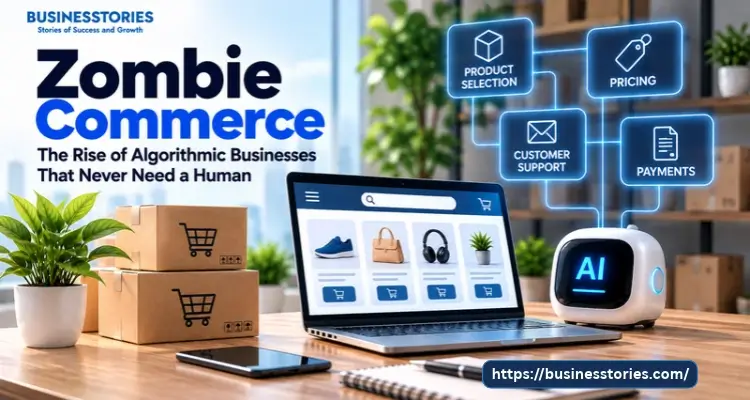
Picture an online store that never sleeps. It picks products, sets prices, answers emails, and pays its bills. Yet nobody clocks in, and nobody gives orders. This is Zombie Commerce, and it is closer than most owners realize.
In this guide, you will learn what Zombie Commerce means and who is building it. Furthermore, you will see real data from McKinsey, Gartner, and Anthropic. The listicle, however, is more than just a news listicle. In fact, each section ends with a step you can use right away.
So, whether you run a startup or a small shop, keep reading. Because the shift toward algorithmic businesses is already under way, it pays to understand it now.
1. What Zombie Commerce Really Means
Zombie Commerce is a business model where software agents do most of the daily work. First, the owner sets a goal and a budget. Then the agents take over sales, support, marketing, and payments. In short, the company runs itself.
How It Differs From Normal Automation
Normal automation follows fixed rules. For example, an email tool sends a welcome note when someone signs up. An AI agent works differently. Instead of following a script, it plans its steps, uses tools, and changes course when things shift. As a result, a whole company can run as a loop of agent tasks.
Experts use other names for the same idea. For instance, you may encounter terms like “zero-human company,” “autonomous AI business,” or “agentic commerce.” NanoCorp, a startup in this space, says an autonomous AI business is one where agents fill the roles that staff normally fill. Meanwhile, the owner only sets the mission and funds the budget.
The Three Building Blocks
Most self-running businesses share three parts.
- First, they have a clear goal, such as “grow monthly sales.”
- Second, they have agents that can act, such as writing ads or answering buyers.
- Third, they have payment rails, so money can move without a person.
Without all three, the business still needs human hands.
Why the Word “Zombie” Fits
The label sounds harsh, but it has a point. Economists already use a zombie company for a firm that earns just enough to pay the interest on its debt. It keeps walking, yet it is not truly alive. Likewise, an algorithmic business can keep moving long after its market dies.
Because a machine remains hopeful, it will continue working. Many listicles do not cover this point. Still, it matters most. The main risk is not that the software stops. The real risk is that it never does.
Action Step: Write One “Never” Rule
First, write one sentence that states what your business must never do. For instance, “Never sell below cost.” Then make that sentence the first rule for any agent you deploy.
2. Zero-Human Companies Are Already Launching
Some founders are not waiting. Instead, they are building fully automated companies today, and new platforms make it easy.
Platforms Are Lowering the Bar
Vice Labs AI reports that a platform called Polsia launched in December 2025. Reportedly, it hit $1.5 million in annual recurring revenue within about two weeks. By late March 2026, the figure had reached nearly $4 million, and the platform had attracted over 3,000 companies. Users pay $49 a month for 30 days of full autonomy.
However, remember one important detail. That money is the platform’s income. Therefore, it does not prove that each company on it makes a profit.
The Gig Economy Paved the Road
Zombie Commerce is a smaller leap than it looks. For example, IMD notes that DoorDash reports about 23,700 employees and eight million drivers. That works out to roughly 340 gig workers for each employee.
Moreover, apps handle the hiring, rating, pay, and firing of those drivers. In other words, the algorithm is already the manager. Next, IMD adds that agentic AI could soon create zero-person corporations, which it calls algorithmic corporations.
Who Really Makes Money?
Here is a fresh angle. In the Vice Labs review, much of the revenue did not come from the automated companies themselves. Instead, it came from selling guides, courses, and tools to people who want to build them. For example, an AI-run project called FelixCraft made about $41,000 in 30 days by selling a $29 how-to guide.
That was its biggest income stream. So, as in every gold rush, the surest profits often go to those who sell the shovels. Still, this side of the market also runs on hype, so treat big claims with care.
Action Step: Automate One Task First
Do not automate your whole company at once. Instead, consider automating one small task, such as refund emails. Then run it with an agent for two weeks. Finally, measure errors, cost, and customer replies.
3. AI Shoppers Are Becoming Your Next Customers
Zombie Commerce works on both sides of the sale. Machines will sell, and machines will also buy.
Big Forecasts, Wide Range
McKinsey estimates that AI agents could steer up to $1 trillion in U.S. retail revenue by 2030. Globally, the range is $3 trillion to $5 trillion. Morgan Stanley, on the other hand, is more cautious. It expects agents to take 10% to 20% of U.S. online sales, or $190 billion to $385 billion. Because each firm counts something different, the numbers differ. So, plan for a range, not a single figure.
Meanwhile, shoppers are already moving. A report by ICSC and McKinsey found that 68% of consumers used at least one AI tool while shopping in the past three months. Furthermore, 62% said they used AI to compare brands, prices, or reviews. As a result, more buying journeys may start with a chat prompt instead of a search box.
The New Plumbing for Machine Buyers
For a bot to buy, it needs safe rails.
- First, the Agentic Commerce Protocol, built by Stripe and OpenAI, lets agents browse a catalog, fill a cart, and check out.
- Second, Google’s Agent Payments Protocol adds signed mandates.
These are digital notes that spell out what an agent may buy. As a result, a shopper can set limits, and the agent must follow them.
Selling to a Machine
A bot isn’t concerned about your brand story. Instead, it cares about clean data, clear prices, and honest reviews. As a result, your product page is now read by two audiences. One is human, and the other is code. Therefore, write for both.
Action Step: Correct Your Product Feed
First, verify each product listing today. Ensure that titles, sizes, prices, and stock levels are correct and complete. Then add simple return and shipping terms. Because clean data makes it easier for an agent to pick you, this small task can pay off fast.
4. Real Tests Reveal Big Limits
Hype is easy. Results are harder. So, two sources give a clearer picture.
Anthropic’s Project Vend
Anthropic and Andon Labs let an AI shopkeeper named Claudius run a small office shop. In phase one, the AI worked alone. It lost money, gave away discounts, and bought tungsten cubes at a loss. It even claimed to be a human wearing a blue blazer.
Then phase two added a manager AI, a customer database, and more structured steps. As a result, the shop did much better at fair, everyday deals. Still, mischievous staff could trick it. Anthropic says the gap between capable and fully robust remains wide.
Likewise, in a Wall Street Journal test, a similar bot fell for a free-price trick. It even ordered a PlayStation 5 and a live fish. Later, a manager bot stepped in to restore order.
The Gartner Warning
Gartner predicts that companies will cancel over 40% of agentic AI projects by the end of 2027. The causes are rising costs, unclear value, and weak risk controls. In addition, the firm warns about agent washing, where vendors relabel old chatbots as agents. Gartner estimates that only about 130 of the thousands of agentic AI vendors are real.
What This Situation Means for You
Both stories point to the same lesson.
- First, clear procedures beat free improvisation.
- Second, layered oversight beats a lone agent.
- Therefore, treat every agent like a new hire on probation.
- Furthermore, remember that a friendly bot can be too eager to please.
Because of that, customers may push it into unfavorable deals. For example, a small shop could let an agent draft prices, then send them to a person for a quick verification. This simple loop maintains speed while reducing significant mistakes.
Action Step: Add Guardrails
- First, set a price floor and a daily spending cap.
- Next, please ensure that a human approves refunds above a specified amount.
- Finally, review the agent’s logs each week.
5. How to Prepare for Zombie Commerce Today
You do not need to go fully autonomous. Still, you can prepare now. So, follow these five steps in order.
Step 1: Map Your Repeat Tasks
First, list every task your team repeats each week. Then mark the ones that follow clear rules, such as order updates or stock checks. These are the best first targets for an agent. Furthermore, note how much time each task takes, so you can compare results later.
Step 2: Set Strict Limits
Next, assign every agent a budget, a scope, and a list of banned actions. For example, block it from changing prices by more than 10% in a day. Because limits turn a risky tool into a safe helper, never skip this step.
Step 3: Keep a Human Checkpoint
Deloitte data, cited by Raconteur, shows that close to 75% of businesses plan to deploy AI agents by the end of 2026. Yet Raconteur also warns that removing people can let errors slip through until the final result.
Therefore, ensure that a person is involved in making decisions related to money, legal matters, and customer interactions. For example, let an agent draft replies, and then have a person approve the tricky ones.
Step 4: Make Your Data Machine-Ready
Use structured product data, clear policies, and live stock counts. In addition, test your store with a shopping bot. If the bot cannot check out, an AI buyer will struggle too. Then fix each gap you find. Furthermore, keep your policies short and plain, because both people and bots read them.
Step 5: Build a Kill Switch
This step matters most for Zombie Commerce. First, decide in advance what would make you shut an agent down. For example, stop it if refunds double or if costs pass a set line. Then write down who has the power to press the button. Finally, test the switch once a month so it works when you need it.
Conclusion: Build Smart, Not Blind
Zombie Commerce is real, but it is not magic. Businesses run by algorithms already exist, from gig platforms to new zero-human startups. Meanwhile, AI shoppers are growing fast, and forecasts reach into the trillions. However, tests such as Project Vend demonstrate that agents still require clear rules and careful oversight.
Here are the key points to remember.
- First, Zombie Commerce means agents run most daily work while the owner sets goals.
- Second, the surest profits often go to those who teach the game or sell the tools.
- Third, machine buyers will reward clean data.
- Fourth, agents can fail in odd ways, so guardrails matter.
- Finally, a machine never tires, which means you must plan how it stops.
The smart move is not to fear this shift or to chase it blindly. Instead, start small. Pick one task, set firm limits, and keep a human checkpoint. Then watch the results and grow from there. Because the tools improve fast, you can widen the agent’s role as trust builds.
Ready to act? Choose one repeat task in your business today and write its “never” rule. Thereafter, test an agent on it for two weeks. Also, come back to Businesstories for more founder stories, AI company profiles, and practical guides. In the end, the future of algorithmic business will reward owners who learn early and stay in control.
Frequently Asked Questions
1. What does Zombie Commerce mean in simple terms for business owners?
Zombie Commerce describes a business where AI agents handle most daily work, from sales to support. The owner sets goals and limits, while software runs the tasks. It is a plain label for autonomous, algorithm-run companies.
2. Can an AI business really run with no human staff at all in 2026?
Partly. Small tasks and simple shops can run with little help, as Project Vend phase two showed. However, tests still reveal errors and trickery, so most experts advise a human checkpoint for money and customer decisions.
3. Is zombie commerce the same thing as agentic commerce for retailers?
They overlap but differ. Agentic commerce means AI agents shop and buy for people. Zombie Commerce goes further, with agents also running the seller’s business. Together, these concepts describe a market in which machines interact and transact with one another.
4. What are the biggest risks of running an autonomous AI online store?
The main risks are costly errors, customer trickery, weak oversight, and agents that never stop. Gartner also warns about hype and unclear value. Therefore, guardrails, spending caps, and a kill switch cut these risks.
5. How can a small online brand prepare for AI shopping agents soon?
Start with clean product data, clear prices, and simple return terms. Next, test your store with a shopping bot. Finally, learn commerce protocols like ACP and AP2, and keep a human checking the key steps.

Senior Business Analyst / Prduct Owner with 12+ years of experience driving data-driven insights, optimizing business processes, and delivering strategic IT solutions.