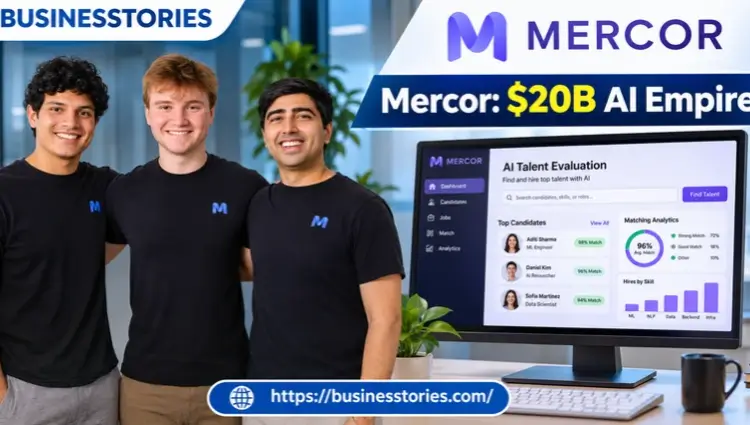
In 2023, three 20-year-olds skipped their sophomore finals to run a side project. Less than four years later, that project is worth $20 billion. Mercor is a San Francisco company that pays experts, such as doctors, lawyers, and engineers, to train and test AI models.
Brendan Foody, Adarsh Hiremath, and Surya Midha started it in January 2023. In November 2026, it raised $750 million at a $20 billion valuation. Its clients include top AI labs and, now, big businesses.
So how did three college dropouts build one of the fastest-growing firms on record? Below, you’ll get the founders’ story and the full funding timeline. You’ll also see how the business makes money, how it compares with rivals, and the risks most coverage skips.
Key Takeaways
- The company sells human expertise to AI builders. Experts write, grade, and check the data used to train and test AI models.
- It’s now worth $20 billion, twice what investors paid in late 2025.
- Its founders became the world’s youngest self-made billionaires at 22, says Forbes.
- Its run rate jumped from about $500 million to $3 billion in about 14 months. But those are gross figures that include expert pay.
- 2026 brought real setbacks, including a data breach that led Meta to pause its work with the company.
What Is Mercor and What Does It Do?
Mercor is a marketplace that connects skilled professionals with AI companies that need their knowledge. Labs pay the platform, and it pays the experts who do the work. In short, it sells know-how, not software seats.
Here’s why that matters. Today’s AI models learn a lot from the open web. However, the web can’t teach a model how a senior lawyer reviews a contract or how a radiologist reads a scan. For that, labs need real experts to write tasks, grade answers, and flag mistakes.
For example, a lawyer might write a tricky contract question. Then she grades how well a model answers it and explains what it got wrong. People call this step post-training. It includes methods like RLHF (reinforcement learning from human feedback).
The startup began as an AI hiring platform. Its software ran short AI interviews to vet candidates at scale. Over time, the founders noticed that AI labs were their hungriest buyers. As a result, the company leaned into supplying expert data for model training.
The company’s Series D post (November 2026) says its network now has well over 5 million experts. It also named three main products:
- Custom tests that check AI on a firm’s real work.
- Post-training to improve models and cut costs.
- Agent training, with practice spaces where AI agents learn challenging tasks.
That third area matters most for what comes next. In 2026, it bought Deeptune, a startup that spent two years rebuilding hundreds of business apps as training environments.
In our view, the clearest way to think about Mercor AI is as follows: it’s a staffing company for the AI era. The “staff” just happens to teach machines rather than fill office seats.
The Founders: From High School Debate to Billionaires at 22
Mercor’s founders met through debate. All three went to Bellarmine College Prep in San Jose, California. In our view, years of arguing a case under time pressure are beneficial training for pitching investors.
Adarsh Hiremath and Surya Midha were childhood friends. They met at about age 10 at school debate events. Later, they met Brendan Foody through high school debate, according to Forbes (2025). The trio was among the best debaters their school ever had.
After graduating in 2021, they split up for college. Foody and Midha went to Georgetown University, while Hiremath went to Harvard. Then, in 2023, all three dropped out during their sophomore year to work full-time on the startup.
Each became a Thiel Fellow, a program that pays young founders to leave college and build companies.
Their first idea was modest. They wanted to match software engineers abroad with US companies that needed freelance coders. Within nine months, that idea reached a $1 million revenue run rate, Fortune reported in 2025.
Here’s a detail most profiles skip. The founders say they made over $1 million a year before raising outside money. That’s rare for a funded AI startup. This success also gave them more leverage in early funding talks.
The payoff came fast. In October 2025, the Series C made all three billionaires. Forbes estimated each held about 22% of the company. At 22, they replaced Polymarket’s Shayne Coplan as the world’s youngest self-made billionaires.
Today, Foody and Hiremath run the company as co-CEOs. Midha chairs the board. Hiremath once said that if not for Mercor, he would have just left college with a degree. Read more founder stories.
Mercor’s Funding Timeline: From $3.6M to $20B
The company has raised money five times in under three years, and each round priced the company far higher. Here’s the full timeline.
| Date | Round | Amount | Valuation | Lead / notable investors |
| Jan 2024 | Seed | $3.6M | Not disclosed | General Catalyst |
| Sep 2024 | Series A | $30M | $250M | Benchmark, plus Peter Thiel, Jack Dorsey, Adam D’Angelo, and Larry Summers |
| Feb 2025 | Series B | $100M | $2B | Felicis |
| Oct 2025 | Series C | $350M | $10B | Felicis, Benchmark, General Catalyst, Robinhood Ventures |
| Nov 2026 | Series D | $750M | $20B | No lead named NVIDIA, Salesforce, Zoom, Benchmark, Felicis, General Catalyst, or Apollo affiliates |
Sources: the company’s Series A press release (2024), TechCrunch (2025), and its Series D post (2026).
Several notable aspects emerge.
First, the Series A came with a profitable business. At that point, the company had a run rate in the tens of millions and was growing about 50% per month, Forbes reported in 2024.
Second, the jumps are getting smaller. The Series B was priced about 8x the Series A. The Series C was five times larger than the Series B. And the Series D only doubled the Series C. That’s normal as a company gets bigger, but it’s a useful reality check. Hypergrowth valuations always slow down.
Third, the Series D included an employee tender. That lets staff sell some shares for cash. It’s a sign the company wants to reward early hires without going public.
Finally, the investor list changed. Early backers were venture firms. The Series D added corporate names like NVIDIA, Salesforce, and Zoom. In our view, that signals where the business is heading: from AI labs toward big enterprise buyers.
How Mercor AI Makes Money (and Why the Big Numbers Need Context)
The company charges clients for expert work and keeps a margin after paying its contractors. The headline revenue numbers are real, but they’re gross figures, so you need to read them carefully.
Start with the growth. Its gross yearly run rate was about $500 million in September 2025. It hit $1 billion in February 2026 and passed $2 billion by June. By November 2026, it had reached about $3 billion. Meanwhile, The Information reported $614 million in gross revenue for the first half of 2026.
Now, let’s discuss the context that most articles leave out. “Gross” means the total that clients pay, including the money that goes straight to experts. So a $3 billion run rate does not mean $3 billion lands in the company’s bank account. The real business is the gap between what labs pay and what experts earn.
That said, the expert payouts are large. In 2026, the startup said it was paying more than $2 million a day to over 30,000 active contractors each week. The Financial Times reported an average of about $95 per hour, with some radiologists earning up to $375.
However, pay varies a lot by role. On review sites, general tasks pay far less than expert work. One AOL report in late 2025 said some contractors got offers of $16 an hour, down from $21, after a project change.
Here’s our take. This is a two-sided marketplace. It wins when it can find rare experts faster than rivals. Yet, it also carries labor costs that pure software companies don’t.
Notably, the company says it now spends about three times as much on AI inference as on employee salaries. That’s a striking sign of how much of its own work runs on AI.
Mercor vs. Scale AI, Surge AI, and Turing
Mercor is one of a few firms that lead the market for specialized data used in AI training. Its edge is skilled pros, not cheap, high-volume labeling.
The market shifted in June 2025. That month, Meta bought a 49% stake in Scale AI. Many AI labs then worried about sharing data with a vendor tied to a rival. As a result, a lot of work moved to neutral vendors, including Mercor and Surge AI.
| Company | Started as | Core strength | Notes |
| Mercor | AI hiring platform | Credentialed experts in law, finance, medicine, coding | $20B valuation (Nov 2026); moving into enterprise agents |
| Scale AI | Data labeling | Large-scale labeling and evaluation | 49% owned by Meta since 2025 |
| Surge AI | Data labeling | High-quality RLHF data for top labs | Strong frontier-lab relationships |
| Turing | Software talent network | Engineering talent and coding data | Sells data packs and training environments |
| Handshake, micro1 | Career/talent platforms | Student and expert networks | Newer to AI data |
The top of the market belongs to just a few names. A widely shared map by investor Deedy Das found that four firms take more than 75% of training-data revenue. Mercor is one of them.
What most comparisons miss is that every vendor is now chasing the same next step. They all want to sell training environments for AI agents, not just labeled data. The Deeptune deal and its APEX benchmarks are its bets.
APEX, launched in October 2025, tests whether AI models can do real work in investment banking, consulting, law, and medicine. Later versions added AI agents and software engineering.
These benchmarks double as marketing. They show buyers exactly where models still fall short. Compare AI data companies.
The Hard Parts: A Data Breach, Big Clients, and Lessons for Founders
The rise hasn’t been smooth. In 2026, a security breach showed how much risk sits inside a fast-growing data company.
In late March 2026, hackers slipped malicious code into LiteLLM, a popular free tool for developers. Mercor was one of the firms hit. Soon after, Meta put its contracts with the company on hold, TechCrunch reported in April 2026.
OpenAI said it was looking into the breach but kept its projects running. Within weeks, contractors had filed at least seven class-action lawsuits, The Wall Street Journal reported.
The breach exposed a real weakness. A small number of AI labs make up much of the human-data market. So losing one big client, even for a while, hurts. Despite that, revenue kept climbing through 2026. That suggests demand for expert data is still strong.
What founders can learn from this story?
- Follow the buyer who pays the most. The founders didn’t plan to be an AI data company. The company noticed that AI labs were its most eager customers and decided to focus on serving them.
- Get to revenue early. Making real money before raising gave the founders more control.
- Treat security as part of the product. For a data firm, one breach can freeze your biggest client overnight.
- Watch your client mix. Spreading revenue across labs and enterprises lowers the risk of any single pause.
- Build proof, not just pitches. Public benchmarks like APEX earn trust with buyers faster than ads.
Conclusion
Three debate partners turned a freelance hiring tool into one of AI’s most valuable suppliers in less than four years. The core lesson is simple: they spotted who needed them most and moved fast.
Remember the key points.
- First, the company sells human expertise to AI builders, and it now targets enterprises too.
- Second, its $20 billion price tag rests on run-rate figures that include expert pay, so treat headline numbers with care.
- Third, the 2026 breach showed how fragile trust can be when a few large clients dominate.
Will Mercor keep its lead as rivals copy its playbook? That depends on whether enterprises buy AI agent training as eagerly as labs bought expert data. We’ll be watching.
Your next step: If you’re a founder, compare your growth plan against the five lessons above. If you’re an expert, review the official listings and contract terms before you apply.
Frequently Asked Questions
1. Is Mercor legit?
Yes. It’s a real, venture-backed company valued at $20 billion in November 2026. It pays experts weekly for AI training work. Still, check pay rates, expected hours, and data terms before you sign any contract.
2. How much does Mercor pay per hour?
Pay depends on the role. The Financial Times reported an average of about $95 per hour, with some radiologists earning up to $375. General tasks pay much less, so check each listing’s posted rate.
3. Who owns Mercor?
It’s a private company. Forbes said each of the three founders owned about 22% in 2025. Backers include Benchmark, Felicis, General Catalyst, NVIDIA, and Salesforce. You can’t buy Mercor shares on a stock market.
4. How old are the Mercor founders?
Brendan Foody, Adarsh Hiremath, and Surya Midha were 22 in late 2025. That year, Forbes named them the world’s youngest self-made billionaires. They started the company in January 2023, during their second year of college.
5. What is the difference between Mercor and Scale AI?
Scale AI grew by labeling huge amounts of data, and Meta owns 49% of it. Mercor AI works with trained experts like lawyers, doctors, and bankers. It also isn’t tied to any one AI lab.

Tabassum Shaik is an Author, Researcher, and SEO Specialist with over 8 years of experience creating informative content on business, startups, entrepreneurship, marketing, technology, and digital trends. She specializes in researching industry trends and transforming complex topics into practical, easy-to-understand insights. Her goal is to help readers stay informed, learn new ideas, and make better business decisions.