
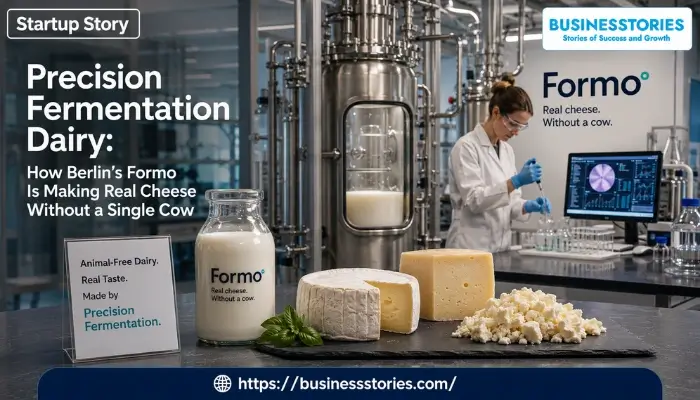
What if you could eat real cheese, and no cow was ever involved? That idea is real today. Berlin’s Formo uses precision fermentation dairy technology to make cheese that melts and stretches just like the real thing. But it comes from microbes, not animals.
Dairy farming is one of the biggest sources of greenhouse gas on Earth. It uses a lot of land and water. Yet people love cheese. They are not going to stop eating it. So Formo found a smarter way. It makes the same proteins found in cow’s milk inside a fermentation tank.
In this article, we look at how Formo works, why it matters, and how this alt-protein startup could reshape the global dairy world.
What Is Precision Fermentation Dairy and How Does Formo Use It?
The Science in Simple Terms
Precision fermentation is not as difficult to grasp as it sounds. Think of it like brewing beer. But instead of making alcohol, the microbes make protein. Formo takes a DNA code and loads it into a tiny microbe. That microbe is then fed in a tank. As it grows, it makes the target protein. In Formo’s case, that protein is casein. Casein is the key protein that gives cheese its stretch and melt.
Once the protein is ready, Formo collects it from the tank. Then it mixes it with plant-based fats and salt. Finally, it uses the same steps as any cheese maker to form the final product. The result looks, melts, and tastes like cheese. But not a single cow was needed.
Two Technology Platforms
Formo uses two different methods. The first is micro-fermentation. Here, Formo grows natural organisms in a tank. A beneficial example is the koji mushroom. It makes protein without any genetic changes. This process is how Formo makes its first range of cheeses, now on sale in shops.
The second is precision fermentation. This method uses microbes that have been engineered to make casein. That is the same protein found in cow’s milk. This is Formo’s next-generation technology. It is still going through regulatory checks. But it will unlock traditional cheeses like mozzarella, gouda, and parmesan at scale.
Together, these two platforms give Formo a strong base. Furthermore, both methods share the same big advantage: no animals, no farms, and far less harm to the planet.
Why the World Needs Animal-Free Dairy Right Now
The Problem with Traditional Dairy
Most people do not consider where their cheese comes from. But the dairy industry has a high environmental cost. Traditional dairy constitutes about 8% of all methane that humans cause. It also uses vast amounts of land and fresh water. On top of that, animals endure harsh conditions on many farms.
Moreover, plant-based options have not resolved the problem. As Formo’s CEO has said, plant proteins do not work well in cheesemaking. They lack the right proteins for melting and stretching. So most plant-based cheeses taste and feel nothing like real cheese. Consequently, dairy lovers have largely ignored them.
Precision fermentation dairy fills that gap. It makes the exact proteins that cheese needs, but without cows. Furthermore, the numbers are striking. Formo’s animal-free casein produces up to 94% fewer methane emissions than cow dairy. That is a big win for the planet.
A Fast-Growing Market
The global dairy market is worth around $700 billion. So even a small share of it is a huge prize. Furthermore, more buyers now want food that tastes excellent and does less harm. Formo sits right at that crossroads. Therefore, the timing for this Formo startup could not be better.
Formo’s Products: From Lab to Supermarket Shelf
The Frischhain Launch
In September 2024, Formo made a significant move. It launched its first range of cheeses in Germany and Austria. The brand is called Frischhain. It covers fresh styles like cream cheese and ricotta. Also in the range is Camembritz, a soft cheese in the style of Camembert.
These products use koji protein. They prove that Formo can make cheese that people want to buy. Currently, the products are in over 2,000 stores, including REWE, BILLA, and Metro. That is real market traction, not just a lab result.
Next-Generation Hard Cheeses
Formo’s next stage is even more exciting. The company plans to launch cow-free hard cheeses. Think mozzarella, Gouda, and Parmesan. However, it must first obtain approval from food regulators. Hard cheeses are where consumers are most loyal to real dairy. Therefore, convincing consumers to switch to animal-free cheese could significantly impact the entire industry.
In addition, Formo is working on an egg alternative called “What Came Third.” It will go to food makers first, not directly to shoppers. This indicates that Formo thinks beyond cheese. Its fermented dairy protein platform can make many kinds of animal-free food ingredients.
Formo’s Funding and Financial Growth
Big Money Behind the Mission
Investors have backed Formo in a major way. In 2024, the startup raised one of the largest funding rounds in alt-protein in Europe. Then, in January 2025, the European Investment Bank gave Formo a €35 million loan. That brought total funding to over $111 million.
The EIB loan matters for two reasons. First, it indicates that Europe sees precision fermentation dairy as a real and valid food technology. Second, it provides Formo with the funds needed to expand its factories and navigate regulatory checks in both the EU and the US. Furthermore, Formo is applying for GRAS status in the US. This is a key step to entering one of the world’s biggest cheese markets.
Scaling to 1,000 Tonnes a Month
Currently, Formo makes triple-digit tons of cheese per month. However, this production is only the beginning. The new funds will help the company reach 1,000 tonnes a month. At that scale, animal-free dairy could match the price of regular cheese. Furthermore, it would let Formo supply stores well beyond Germany and Austria.
Key investors include EQT Ventures, REWE Group, and Happiness Capital. The fact that REWE is both an investor and a retail partner gives Formo a fast and direct route to shoppers.
The Regulatory Road Ahead
Navigating EU Novel Food Rules
Getting precision-fermented dairy approved in Europe is not straightforward. The path is long and full of steps. Under the EU Novel Food Regulation, any ingredient produced by a new process must undergo a formal safety assessment. EFSA handles this review. It can take years, often due to rounds of questions and slow replies.
Formo’s head of public affairs, Christian Poppe, has been open about this problem. He says the two biggest issues are a lack of clarity and slow feedback from regulators. To fix this, Formo co-founded Food Fermentation Europe. This group brings startups together to speak with regulators as one voice. Its main goal is to make the approval path clearer and faster.
Moreover, the European Commission put forward a new biotech act in late 2025. It aims to speed up approvals and give EFSA more staff to handle new food files. So progress is being made. But it is still not as fast as the industry needs.
The US Path
In the US, the route is different. Formo is applying for GRAS status for its case. GRAS stands for “Generally Recognized as Safe.” This is a self-certification pathway in which companies certify that their ingredients are safe. The company aimed to finish this process by the end of 2025. Once completed, it paves the way for access to the expansive US cheese market.
Formo and the Bigger Picture: A Sustainable Food Future
Targeting 10% of Europe’s Dairy Market
Formo has set a bold goal. It wants to replace 10% of Europe’s animal-based dairy with animal-free options by 2030. That is a giant ambition. However, the company has a clear strategy to achieve this goal. It has the technology, the retail presence, the funding, and the industry support.
Furthermore, global trends back Formo’s direction. The EU’s Farm-to-Fork Strategy calls for big cuts in animal-based food by 2030. Governments are investigating how to cut farm emissions. Precision fermentation dairy can match the taste of real dairy. And it does far less harm to the planet. As a result, Formo is not just a food startup. It is also a climate tech company.
What Sets Formo Apart
Many alt-dairy startups exist today. But Formo stands out for three reasons. First, its products taste and work like real cheese. Second, it has two technology platforms, giving it a path from today’s market to tomorrow’s. Third, it enjoys strong backing, including from the EU itself.
Furthermore, Formo builds around the science of cheese. It does not try to copy dairy with plants and hope for the best. Instead, it recreates the exact molecules that make cheese work. That is a harder problem to solve. But it is also the one that matters most to cheese lovers.
Conclusion: Why Precision Fermentation Dairy Could Change How We Eat
Formo is doing something bold. It is taking one of the world’s most loved foods, cheese, and rebuilding it from the ground up. Using precision fermentation dairy technology, it makes the exact proteins that give cheese its taste and texture. But no cows are needed. No farms. No methane.
The company still faces challenges. Hard cheeses are not yet on sale. Approvals take time. And scaling up production is a real test. But the progress is clear. Formo’s products are in over 2,000 stores. Its total funding has passed $111 million. And the EU itself is backing its growth.
Moreover, the world needs this kind of fix. Dairy farming hurts the climate. Plant-based options let cheese lovers down. Precision fermentation fills that gap. It gives cheese lovers what they want, and it is good for the planet too.
So if you care about food, climate, or startups, Formo is a name to watch. Follow its challenging cheese launch. Track its GRAS approval in the US. And keep an eye on its goal to take 10% of Europe’s dairy market by 2030. The cow-free cheese revolution is already underway.