
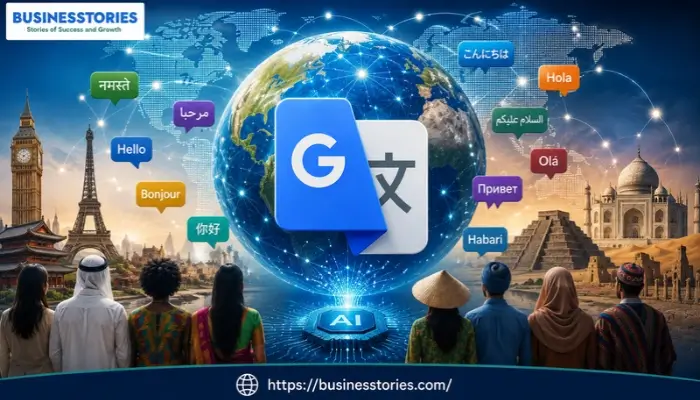
Every time you open Google Translate, you assume your language will be there. However, well over 3 billion people find their hope shattered. Their languages simply do not exist in the digital world. This is not just a tech problem. It shows a deeper truth. The geopolitics of AI language inclusion shapes who is heard and who is excluded or left out.
It also shapes who can join the modern digital economy and who cannot. Language tools have become strong gatekeepers of our time. When AI translation works for only a few of the world’s 7,000-plus languages, these tools decide which groups can access information and join global trade. They also decide which cultures stay alive online.
Google Translate now supports about 133 languages. That sounds good until you learn it covers less than 2% of all living languages. The gap is huge. And the results are deeply political.
In this article, we look at the hidden forces behind AI language picks. We ask why some languages make the list, and others fall off the map. More than that, we uncover what this phenomenon means for global power, money, and the future of language itself. Let us dive into the world where code decides whose words truly count.
The Digital Language Divide: How Big Is the Gap?
Before we can grasp the geopolitics of AI language inclusion, we must see how wide the divide really is. The statistics reveal a stark reality. Out of about 7,100 languages spoken on Earth today, fewer than 500 have any real online presence. That means over 90% of all human tongues stay hidden from the web.
They have no Wikipedia pages. They have no machine translation. And they have no voice tools. The top end is even more extreme. English alone takes up around 60% of web content. Add in Chinese, Spanish, Arabic, and a few others, and you cover more than 90% of the internet. The rest gets split among thousands of languages.
Each one holds unique cultures and ways of thinking. But they remain nearly invisible online. This gap maps almost perfectly onto old patterns of global wealth.
Languages from rich nations get top care. Languages from the Global South get left out. This disparity is not a coincidence. This situation arises from deliberate decisions regarding how to allocate funds and which users technology companies prioritize.
UNESCO warns that about 40% of all languages face the risk of digital death.
This does not mean that people will stop speaking these languages. It means these languages will have no keyboards, no spell-checks, no search tools, and no AI translation. When young people cannot use their native tongue online, they slowly shift to bigger languages. The chain of passing language from parent to child breaks down.
Consider this real case. Oromo has over 37 million speakers across Ethiopia and Kenya. Yet until very recently, it had almost no support from major translation tools. At the same time, Icelandic, spoken by just 350,000 people, enjoys strong digital backing.
Why? Iceland has a rich economy and state-funded language programs. Oromo-speaking areas face deep gaps in funding and political power. The divide is not about speaker count. It is about who holds power.
Who Decides Which Languages Get AI Support?
This question lies at the core of the geopolitics of AI language inclusion. Who actually picks the winners and losers? There is no open or fair process. A select group of major tech companies makes these decisions in secret. Google, Microsoft, and Meta act as the main gatekeepers of digital language life.
These firms rank languages by three things.
- First comes money: how much buying power do the speakers have?
- Second comes data: is there enough digital text to train the AI?
- Third comes strategy: does the language fit a market the firm wants to enter?
Notice what they leave out. They ignore cultural worth. They skip over language variety. And they overlook basic digital rights. This money-first logic creates a nasty loop. Languages that already have digital content receive more funding. Languages with no digital stuff stay hidden because firms say there is “not enough data.”
This roundabout thinking locks out weaker languages forever. Experts call this “digital language redlining.” The term echoes old housing biases that shut certain groups out of neighborhoods.
Beyond firms, states also play a big role. France, China, and Russia spend heavily on language tech to boost their national tongues and spread their cultural reach. In the meantime, many African and native nations lack the funds to push their languages into the digital space. The result is a global language pecking order that mirrors old colonial-era power lines.
Google launched its 1,000 Languages Initiative in 2022, aiming to build AI models for the thousand most-spoken tongues. That marks real progress. Still, even 1,000 languages cover just 14% of the world’s language diversity. One company still holds the power to decide which tongues deserve a digital future.
Colonial Legacies: The Roots of AI Language Bias
You cannot fully grasp the geopolitics of AI language inclusion without looking at its colonial roots. The top languages in AI today—English, French, Spanish, and Portuguese—did not become dominant by chance. They spread through centuries of conquest, forced rule, and trade power. AI language systems take in and boost these old power lines.
When colonial rulers drew borders across Africa and Asia, they also set up language ranks. European tongues took over schools, courts, and trade. Native languages faced harsh crackdowns. Today, AI, primarily trained on European languages, maintains these same ranks while presenting a facade of technological fairness. The code does not see itself as biased.
It just mirrors the data it learned from, which was built by centuries of colonial rule. Look at India. Google Translate does well with Hindi and Bengali. But India has 22 official languages and hundreds more with millions of speakers. The quality drops hard for Santali, spoken by over 7 million, or Bodo, with 1.5 million speakers. These are large, widely spoken languages. Yet they get very little support because they lack the digital trail that colonial languages built over time.
Research from Stanford’s Institute for Human-Centered AI shows that big language models do much worse on African languages, Native American tongues, and South Asian languages outside the top few. The gap touches more than just translation quality. It hits content checks, feeling analysis, and even access to health help and legal aid.
Some thinkers call this “data colonialism.” Like old empires took gold and timber, today’s tech firms pull language data from weaker groups. They use it to build rich AI systems while giving little back to the people who spoke the words. We need to rethink who owns language data and who benefits from it, so we can break this cycle.
Real Harm: What Language Exclusion Costs People
When AI tools shut out a language, the harm spreads through every part of life. This is not a small bother. It causes real, lasting damage. Think about health. During the COVID-19 crisis, correct health news spread fast in English, Chinese, and Spanish. But Quechua speakers in the Andes and Fulani speakers in West Africa fought hard to obtain life-saving facts.
Machine translation could have filled this gap. Instead, the lack of AI language inclusion put public health at risk in places that were already weak. The education gap is equally impactful. UNESCO states that 40% of people worldwide cannot learn in a language they speak or grasp well. AI learning tools could make knowledge open to all.
But in real life, these tools mostly help students who already speak the big languages. A child who speaks Wolof gains almost nothing from an AI teacher built only on English and French.
Money chances also follow language lines. Online shops, freelance sites, and digital services all run mostly in a few big tongues. Business owners in regions with unsupported languages face an initial disadvantage. They cannot easily sell goods, write deals, or reach global chains. The World Bank says that growing digital language access could free up trillions of dollars in value across the Global South. Yet the spending gap stays wide.
Social and civic life also suffers. When state services and legal information are available only in major languages, entire communities are excluded from the democratic process. They cannot fully know their rights. They are unable to hold leaders accountable. When language is blocked, political say is blocked too. In a time where AI runs more and more of our info flow, the stakes have never stood higher.
Grassroots Movements: Fighting Back for Language Justice
Against these steep odds, a rising global push fights back against AI language shutouts. Small groups, school projects, and advocacy organizations are working diligently to bring neglected languages into the digital age. Their work shows that the geopolitics of AI language inclusion is still evolving. It is a fight where local action can spark real shifts.
One bright light is the Masakhane project, a ground-up research push for African languages. Built by researchers across the continent, Masakhane has made machine translation for over 30 African tongues that big tech firms ignored. The project runs on shared ownership and open teamwork. Instead of waiting for Google, Masakhane members train their models with locally gathered data.
Their work proves you do not need Silicon Valley tools to build effective language AI. You need drive, local ties, and deep respect for language differences.
Native groups in North America show another strong case. The Cherokee Nation has put heavy funds into digital language safekeeping. They built Cherokee screens for main computer systems and made online learning hubs. The Māori community in New Zealand pushed hard and won support for Māori in Google Translate. These wins show that when groups band together and call for change, tech firms can and do answer.
World bodies are also joining the fight. The UNESCO Decade of Indigenous Languages (2022-2032) places digital language access at its core. The Mozilla Common Voice project gathers voice clips in dozens of pushed-out languages, building open data sets for anyone to use.
What You Can Do: Steps to Support Language Inclusion
You might ask what one person can do about a problem of this magnitude. The truth is a lot. Big shifts need group action. But your choices and voice still drive change. Here are clear steps to support language variety in the digital age.
1. Give to Open Language Data Work
If you speak an underserved language, help open data projects like Mozilla Common Voice or Tatoeba. Share voice clips, translate lines, or check current work. Even a few hours of help can grow the data pool for your tongue.
2. Push for Digital Language Rules
Urge your leaders to back digital language access. Ask them to fund language tech study for pushed-out tongues. Tell them to make state web tools work in all languages spoken in your area. South Africa and Wales show that state leadership can spark real headway.
3. Back Local-Led Tech Efforts
Groups like Masakhane, FirstVoices, and the Living Tongues Institute need gifts and helpers. Even small cash gifts keep their key work going. You can also share their findings and push for seats at tech talks and rule forums.
4. Pick Your Tools with Care
When you pick digital tools, check if they support many languages. Go with services that put funds into broad language reach. If a company does not support your language, send them a note. User wants do matter. When enough folks ask for language help, firms pay heed and shift their focus.
5. Learn and Share About Language Richness
Knowing is the base of doing. Find out about tongues in your area and worldwide. Grasp the risks they face. Share what you learn. The more folks see language variety as a shared human treasure—not just a tech snag—the stronger the push for digital fairness will grow.
The Road Ahead: Language in the Age of AI
The path of AI language access will rest on choices made in the next few years. Some signs give measured hope. New machine learning tricks cut the data needed to train translation tools. Methods like transfer learning let AI pick up new languages with much less data than before. Open-source models, such as Meta’s No Language Left Behind (NLLB) project, also show that top-quality translation for low-data languages is now within reach.
But tech alone cannot resolve the problem. The geopolitics of AI language inclusion will continue to show wider power gaps unless we step in with purpose. Governments must set rules that demand language access as a must for AI use.
The EU AI Act provides one useful model, with rules that tackle bias in AI tools. Laws could be enacted to promote language variety in regions with multiple languages. At the same time, the African Union has started to build a continent-wide AI plan that puts weight on African languages in digital shifts. These rule moves show a growing sense that language access is a ruling issue, not just a market pick.
Conclusion: A Digital Voice for Every Language
The geopolitics of AI language inclusion is not some far-off concept. It touches real lives, real groups, and real futures each day. When Google Translate and other AI tools pick which tongues count, they shape who can reach knowledge, join the economy, and keep their culture alive online. The current setup, pushed by money goals and colonial roots, leaves billions of people underserved. However, this truth is not immutable.
In this piece, we walked through the scale of the digital language gap. We saw the hidden gears that pick which tongues receive AI help. We looked at the deep harm caused to health, schools, and money-making chances. Also shone light on the bold local efforts, from Masakhane to the Cherokee Nation, that prove group action can break corporate control and widen digital language fairness.
The future requires actions at all levels. Governments must set rules for language access. Tech firms must look past pure profit. World bodies must treat language variety as a shared global resource. And each of us can help through voice, data gifts, and smart tool picks. Every tongue truly counts in the push for digital language justice.
The real question is not whether AI can back all languages. Tech-wise, it can. The question is whether we will ask for it. Let us choose a future where every tongue finds a digital home and the geopolitics of AI language inclusion leans toward fairness.
Frequently Asked Questions
Q1: How does the geopolitics of AI language inclusion affect daily life?
It shapes access to health facts, school tools, and job chances. When AI skips your tongue, you face blocks to key web tools and world participation.
Q2: Why do widely spoken languages still lack Google Translate?
Money goals, not speaker counts, drive the picks. Tongues in poorer areas or with thin web data are pushed aside despite millions of speakers.
Q3: Can grassroots projects truly push back against big tech control?
Yes. Masakhane built AI translation for 30-plus African languages. Local-led work shows real language reach can happen without big firm support.
Q4: What role do governments play in AI language rules?
States can demand tongue support in web services, fund language tech study, and set AI rules that need a language range as a base for use.
Q5: How can one person help shrink the digital language gap?
Contribute to open data sets like Common Voice. Push for fair rules. Back local-led efforts with gifts. Ask firms to add your tongue to their tools.

Senior Business Analyst / Prduct Owner with 12+ years of experience driving data-driven insights, optimizing business processes, and delivering strategic IT solutions.