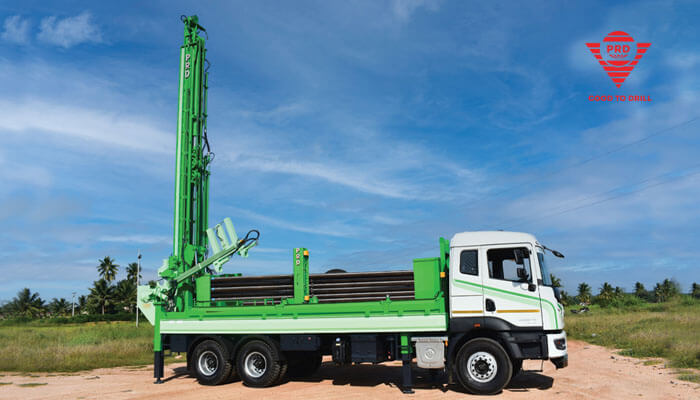
Every borewell, mine, and bridge starts with a hole in the ground. So who builds the machines that make those holes? One answer comes from a small town in South India. PRD Rigs began as a tiny workshop in 1972. Today, it ships drilling rigs to 75 countries.
This brand story shows how PRD Rigs grew, what it builds, and why its drilling technology matters. Along the way, you will also learn how to pick the right rig for your own work. So, let’s dig in.
The PRD Rigs Story: From a Small Workshop to a Global Brand
Every major brand has a modest beginning. For PRD, that start was an engineering workshop in Tiruchengode, Tamil Nadu. The founders opened the workshop in 1972, led by T. P. Thangaraj, who still chairs the PRD Group.
The Early Years
At first, the team fixed and built machine parts. Then, in 1985, the company made its first drilling rig. Those early rigs ran fully on air power, or pneumatics. They were simple. However, they did the job well, and farmers needed them badly.
Why did that matter so much? Back in the 1960s and 1970s, the region faced a harsh water crisis. As a result, local makers learned to build rigs that could reach deep groundwater.
Over time, Tiruchengode earned the title of the ‘Borewell Hub of India.’ Today, more than half of the borewell rigs at work across India come from this one town. Plus, the rig trade here supports over two lakh (200,000) jobs, directly or indirectly.
Going Global
The next significant advancement occurred. In the early 1990s, PRD built its first hydraulic drilling rig. Soon after, it began selling abroad. By 1999, Paranthaman Exporters, its export arm, was fully operational.
The results speak loudly. India’s government gave PRD Regional Export Awards every year from 2005 to 2014. Today, the company has shipped more than 4,000 rigs to 75 countries. It also has a team of over 1,000 skilled workers.
A Unique Insight: The Power of a Cluster
Here is something most articles miss. PRD did not grow alone. Instead, it grew inside a whole town of truck body builders, welders, and rig owners. For decades, these people swapped skills and spare parts every day.
So, PRD had a ready supply of talent and feedback on its doorstep. In short, the town worked like a living test lab. That is why the history of PRD Rigs is really the story of an entire community. And it explains why a brand from a small town can now compete with global giants.
Key Milestones in PRD Drilling Technology
Great tools rarely appear overnight. They develop gradually, one step at a time. Let’s explore the key milestones in PRD’s drilling technology.
From Air Power to Hydraulics
As noted, PRD’s first rigs used air power. Then, in the early 1990s, it switched to hydraulics for water well rigs. Why does that matter? Simply put, hydraulics give more force and finer control. So, drillers could go deeper and work faster with less strain.
Smart Controls Arrive
Next, in the early 2000s, PRD added PLC controls. A PLC is a small computer that runs the rig’s moves. As a result, rigs used fewer workers and drilled faster. They also cut costs per hole. Plus, operators could watch depth and pressure more closely.
Quality You Can Prove
Meanwhile, PRD worked hard on quality. It became the first drilling rig maker in India with ISO 9001:2015 certification. That label tells buyers the factory follows strict quality steps.
For export buyers, that kind of proof matters a lot. So, buyers in Africa, Asia, and the Middle East can trust the rig before they ever see it.
Made in India, Built for Big Projects
One recent win stands out. PRD built the GD4 geotechnical rig for soil testing. Previously, Indian builders often imported these rigs. PRD, however, delivered eight GD4 rigs to L&T Geostructure and L&T Construction.
Moreover, PRD says it was the first Indian maker to supply geotech rigs to an international standard for India’s high-speed bullet train project.
Learning From the World
Also, PRD does not innovate in a bubble. It works with tech partners in Australia, Europe, and South Africa. Thus, it can add the latest features to its mining drill rigs and soil testing machines.
Here is our take. PRD’s real skill is not one big invention. Rather, it is steady, small upgrades that keep the price fair. For many buyers in Africa and Asia, that balance beats a costly, high-tech rig they cannot service.
The PRD Rigs Product Range: One Brand, Many Jobs
So, what does PRD actually manufacture? In short, it makes rigs for almost every drilling job on land. Let’s break the range down.
Mining and Exploration Rigs
First, there are rigs for finding minerals. These include:
- Diamond core rigs that pull up solid rock samples.
- Reverse circulation (RC) rigs that bring up crushed rock fast.
- Grade control and air core rigs for checking ore quality.
- Multi-purpose drills that switch between methods.
In addition, PRD makes blast hole rigs for open pit mines and quarries. These use rotary or DTH (down-the-hole) hammers. Meanwhile, its dewatering rigs drill both up-and-down and sideways to pull water out of mines.
Water Well Rigs
Water is where PRD began. Its water well drilling rigs still form a core part of the line. For example, the PRD DR 2000 uses the rotary method. It can drill deep holes for water wells and mine dewatering. In many dry regions, these rigs help bring clean water to towns and farms.
Geotechnical and Construction Rigs
Then there are rigs for builders. PRD’s geotechnical drilling rigs sit on crawler tracks. So, they move easily across rough sites. They also come with an auto-trip hammer for soil tests. Plus, one top-head drive handles coring, augering, and sampling.
Special Jobs
Finally, PRD builds rigs for niche tasks. These include solar farm piling and cathodic protection. (That is a method that stops pipes and tanks from rusting.) Both fields are growing fast. So, PRD now also sells into the solar and pipeline markets.
Built Your Way
Here is what stands out. PRD lets buyers customize almost everything. You can add extra features. You can even pick the paint color. Furthermore, PRD says it keeps lead times short, so you wait less for delivery.
As a result, a driller in Ghana and a miner in Saudi Arabia can each get a rig that fits their exact site.
How PRD Rigs Drive Efficiency on Site
Speed matters in drilling. After all, every idle hour costs money. So, how do modern rigs save time and cash? Let’s look at the data first.
What the Industry Data Says
Recent industry reports show strong gains from automation. For example, automated drilling systems have cut idle time by about 35%. They have also raised rig efficiency by 22% to 30%. Meanwhile, analysts expect the global mining drill rigs market to grow about 6.2% per year from 2025 to 2031.
However, full automation is still being developed. Some experts say AI-run exploration drilling may need 10 to 15 more years to go mainstream. So, for now, smart and simple designs win the day.
Where PRD Rigs Fits In
That is where PRD shines. Its rigs aim for a high output for every rupee or dollar spent. In fact, the company describes its products as fuel-efficient and built for strong output against running costs. Here is how that plays out:
- Faster setup: Crawler rigs move on their own. As a result, crews spend less time hauling gear.
- Fewer hands: PLC controls reduce the crew needed per shift.
- Less downtime: A wide service network means parts arrive sooner.
- Right-sized rigs: Custom builds mean you don’t pay for power you won’t use.
The Service Edge
Moreover, PRD runs branches in Kenya, Tanzania, Ghana, Nigeria, Mali, Guinea, Burkina Faso, and Sri Lanka. It also has dealers in Australia, Southeast Asia, the Middle East, and Latin America. Why does this matter? Because a broken rig with no local support is just scrap metal.
Our Unique View
Here is a fresh angle. Most buyers compare rigs by price tag. Yet the smarter number is cost per meter drilled. A cheap rig that breaks often costs more over time. In contrast, a mid-priced rig with local service and spare parts often wins. In our view, this simple math is what PRD built its brand on.
How to Choose the Right Drilling Rig: Practical Steps
Ready to buy or rent a rig? Then follow these steps. They work whether you pick PRD or another brand.
Step 1: Define Your Job Clearly
First, write down what you need to drill. Is it water, minerals, or soil samples? Also note your target depth and hole size. For instance, a water well at 300 meters needs a very different rig than a 30-meter soil test.
Step 2: Study Your Ground
Next, learn your rock and soil type. Hard rock often suits DTH hammers. Soft ground, however, may suit rotary or auger drilling. If you are unsure, ask a local geologist first. After all, a wrong match can slow your work and wear out bits fast.
Step 3: Check Site Access
Then, look at the roads and terrain. Truck-mounted rigs travel fast on highways. In contrast, crawler rigs handle mud and slopes better. So, please choose the rig that can actually reach your site. Also, be sure to check for narrow bridges and weight limits along the route.
Step 4: Ask About Service and Spares
This step is easy to skip, but don’t. Ask the maker where the nearest service center is. Also ask how fast spare parts arrive. As noted earlier, local support often decides your real costs.
Step 5: Compare Cost per Meter
Now, run the numbers. Add the rig price, fuel, crew, parts, and repairs. Then divide by the meters you expect to drill. This provides you the true cost of drilling per meter.
Step 6: Request a Demo or Reference
Finally, ask for a site demo or a customer contact. Talk to a driller who uses the rig every day. Their honest view is worth more than any brochure.
As a bonus tip, consider custom options. Brands like PRD can tweak a rig to your site. As a result, you avoid paying for features you will never use.
Also Read: To understand how modern construction methods are evolving, you can explore What Mivan Construction Is and Why Is It Popular? for more profound insights.
Conclusion: Why PRD Rigs Matter in Modern Drilling Technology
The story of PRD Rigs is one of steady growth. It began as a small workshop in 1972. Then it moved from air-powered rigs to hydraulics. Later, it added smart PLC controls. Today, it has shipped more than 4,000 rigs to 75 countries.
Along the way, PRD demonstrated an important principle. You don’t need a giant city or a giant budget to lead in drilling technology. Instead, you need great skills, fast feedback, and a focus on what buyers really need. Tiruchengode gave PRD all three.
We also saw how the brand drives efficiency. Its rigs aim for high output at a fair running cost. Plus, custom builds and a wide service network help cut downtime. And as automation grows, PRD’s step-by-step upgrades keep its rigs practical and affordable.
So, what should you take away? Above all, judge a rig by its cost per meter drilled, not just its price tag. Next, check service support before you buy. And finally, match the rig to your ground, depth, and site access.
Your next step: Please create a brief list of your drilling requirements today. Then contact two or three makers, including PRD, and ask for a quote and a demo. Compare them based on a true cost per meter. That one move can save you thousands over a rig’s life.
Frequently Asked Questions
1. What are PRD Rigs and what kind of drilling machines do they make?
PRD Rigs is an Indian drilling rig maker founded in 1972. It builds water well drilling rigs, mining exploration rigs, blast hole rigs, dewatering rigs, and geotechnical drilling rigs for buyers in 75 countries.
2. Where is PRD Rigs based, and why is that town so famous for its rigs?
PRD Rigs has its home in Tiruchengode, Tamil Nadu. Locals call this town the Borewell Hub of India because more than half of India’s borewell rigs come from here, thanks to decades of local skill.
3. How does modern drilling technology improve efficiency on a job site?
Modern drilling technology uses hydraulics, PLC controls, and automation. These features cut idle time, reduce crew size, and speed up work. Industry data shows automation can lift rig efficiency by up to 30%.
4. Are PRD water well drilling rigs effective for deep borewell drilling jobs?
Yes. PRD water well drilling rigs, like the DR 2000, use the rotary method to drill deep holes. They suit water supply and dewatering jobs, and buyers can customize them for local ground conditions.
5. How can I choose the right drilling rig for my next mining project?
Start by defining your target depth, rock type, and site access. Then check local service support. Finally, compare each rig’s cost per meter drilled, not just its upfront price, before you decide.

Tabassum Shaik is an Author, Researcher, and SEO Specialist with over 8 years of experience creating informative content on business, startups, entrepreneurship, marketing, technology, and digital trends. She specializes in researching industry trends and transforming complex topics into practical, easy-to-understand insights. Her goal is to help readers stay informed, learn new ideas, and make better business decisions.