
Two decades ago, if you wanted to launch a tech startup, you first had to buy servers. Rent space in a data center and hire a team of IT engineers before you write a single line of code. Then came Amazon Web Services (AWS), and suddenly, anyone with a credit card could access virtually unlimited computing power on demand. That single shift unleashed an explosion of innovation that gave birth to companies like Airbnb, Netflix, and Stripe. Today, synthetic biology stands at the same inflection point. Bio-Foundry-as-a-Service (BFaaS).
Just as AWS abstracted away the complexity of managing physical servers, BFaaS platforms are abstracting away the staggering complexity of engineering biology at scale. You can now rent biological design-build-test capabilities through the cloud, rather than spending millions to build your own foundry.
This is not a distant prediction. It is happening right now. In 2025, the global synthetic biology market reached $18.7 billion. Bio-Foundry-as-a-Service became the fastest-growing segment, with platforms like Ginkgo Bioworks, Zymergen, and TeselaGen at the forefront. By 2030, analysts project the BFaaS market alone will surpass $4.2 billion.
This article explores why this shift changes everything about how we manufacture, from pharmaceuticals to textiles, from food ingredients to sustainable materials.
What Is Bio-Foundry-as-a-Service? A Simple Breakdown
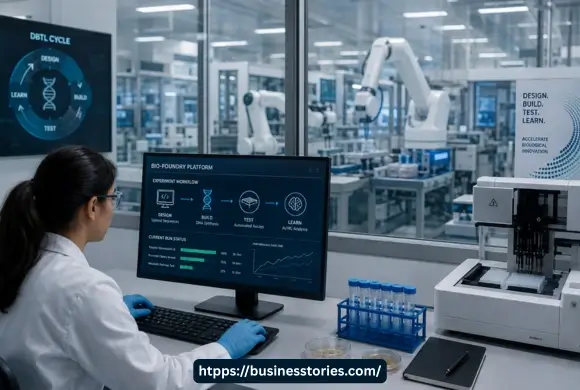
At its core, Bio-Foundry-as-a-Service is precisely what it sounds like: a pay-as-you-go model for biological engineering. A company contracts with a BFaaS provider instead of building a wet lab, buying expensive liquid-handling robots, hiring PhD scientists, and maintaining high-throughput screening infrastructure.
These providers run large biofoundries with robotic work cells, DNA synthesizers, mass spectrometers, and bioreactors, and they let customers use their facilities for specific experiments or organisms.
When you use AWS, you don’t think about the physical server sitting in a Virginia data center. You spin up a virtual machine through a web dashboard. Similarly, with BFaaS, a startup designing a new enzyme for industrial catalysis doesn’t think about pipetting protocols or incubator calibration.
They upload their genetic designs through a digital portal, and the foundry’s robots execute the build and test cycles automatically. Results arrive back as data files ready for analysis, often within days rather than months.
The technology stack behind BFaaS is genuinely remarkable. Modern biofoundries integrate laboratory automation with artificial intelligence and machine learning in a closed loop. The Design-Build-Test-Learn (DBTL) cycle, the fundamental engine of synthetic biology, runs entirely on rails.
Why BFaaS Is SynBio’s AWS Moment — The Parallel Is Uncanny
To truly grasp why this development matters, let’s walk through the historical parallel in detail. Before AWS launched in 2006, building a tech company followed a painfully predictable path. Founders raised venture capital, a large chunk of which immediately went to servers, networking gear, and IT staff. The capital barrier meant that only well-funded teams could even attempt to build internet-scale applications. Innovation was gated by access to physical infrastructure.
AWS changed the equation entirely. By offering compute, storage, and networking through simple APIs with per-hour billing, it collapsed the cost of experimentation to near zero. A developer could spin up a hundred servers for a weekend test, pay thirty dollars, and tear them down on Monday.
This is what economists call a reduction in transaction costs, and when those costs plummet, innovation explodes. The number of venture-backed software startups tripled between 2006 and 2012. And nearly every one of them ran on AWS.
Now apply that exact logic to synthetic biology. Before BFaaS, creating a genetically engineered organism required you to physically build a lab, hire a scientific team, and spend months, often years, iterating through laboratory workflows. Today, Bio-Foundry-as-a-Service platforms provide the same zero-friction access to biological engineering infrastructure that AWS provides to computing infrastructure.
A lean team working from a co-working space can design, build, and test thousands of microbial strains simultaneously without ever touching a pipette. The barrier is no longer capital; it is imagination.
How BFaaS Rewrites the Rules of Manufacturing
Manufacturing has followed the same basic playbook since the Industrial Revolution: extract raw materials. Process them in energy-intensive factories using chemical or mechanical transformations. And ship finished goods through complex supply chains. This model has produced enormous prosperity. But it also comes with baked-in vulnerabilities, fragile supply chains, massive carbon footprints, and geographic concentration that turned a single factory shutdown in Wuhan into a global economic crisis in 2020.
Bio-Foundry-as-a-Service rewrites this playbook from the ground up. Instead of manufacturing products through chemistry and mechanics, BFaaS enables manufacturing through biology. This involves programming microorganisms to produce target molecules through fermentation. This process operates at ambient temperature and pressure and uses renewable feedstocks.
The factory is not a smokestack facility in a distant industrial park; it is a distributed network of biofoundries and fermentation partners that can be spun up anywhere in the world on demand. This represents nothing less than the dematerialization of manufacturing infrastructure.
On-Demand Biomanufacturing Becomes Reality
The COVID-19 pandemic occurred. Manufacturing capacity became the bottleneck immediately after vaccine development accelerated. A pharmaceutical production line cannot be built in weeks, the world learned. BFaaS lets you change the organism and feedstock to reprogram a fermentation facility to produce a different molecule.
This adaptability is revolutionary. Resilience (formerly National Resilience) and Ginkgo Bioworks created a biomanufacturing network in 2025 that could switch between vaccine components, therapeutic proteins, and small-molecule drugs in 60 days, a process that previously took 18 to 24 months.
Sustainable Production at Scale
The sustainability dimension is equally transformative. Traditional chemical manufacturing of a single kilogram of nylon precursor generates approximately 8 kilograms of CO₂ equivalent. Engineered microbes in a BFaaS foundry can produce the same molecule through fermentation, reducing that footprint by 60 to 80 percent and eliminating toxic solvents and heavy-metal catalysts.
Companies like LanzaTech, working in partnership with BFaaS platforms, already produce industrial chemicals from captured carbon emissions. Meanwhile, Modern Meadow uses bioengineered yeast to manufacture animal-free collagen for the fashion and cosmetics industries, entirely bypassing livestock agriculture.
Decentralized and Resilient Supply Chains
Decentralized production may be the most strategic shift. Today’s supply chains focus on manufacturing in low-cost regions, creating single points of failure that geopolitical tensions or natural disasters can disrupt overnight. BFaaS allows a new model: a global foundry network, local fermentation production, and product manufacturing near consumption.
You ship a vial of engineered cells, not a container ship of finished goods, because the organism owns the intellectual property. This flips global trade economics and offers a real path to supply chain resilience that nations have been chasing since 2020.
Real-World Use Cases That Prove BFaaS Is Already Here
The best way to understand BFaaS is to look at what it already produces. These are not science fiction scenarios—they are commercial products you can buy today, built on biofoundry platforms that compressed development timelines from years to months.
Pharmaceuticals: CRISPR Therapeutics and Engineered Enzymes
In 2024, a biotech startup called Profluent used a BFaaS platform to design and validate a novel CRISPR gene-editing enzyme in just 11 weeks, a process that previously required 18 to 24 months of laboratory work. By using automated processes to test many designs at once, the team looked at over 50,000 enzyme versions and found three that worked much better for editing.
The company never owned a pipette. The entire program ran on rented biofoundry capacity, and the total cost came in under $2 million — roughly one-tenth of what a traditional approach would have cost.
Sustainable Materials: Spiber and Brewed Proteins
Spiber, a Japanese biomaterials company, produces a spider-silk protein called Brewed Protein through microbial fermentation. The company’s initial strain development relied heavily on BFaaS partnerships for high-throughput screening and optimization. The result? A textile material that outperforms petroleum-derived nylon in strength-to-weight ratio while being fully biodegradable.
The North Face released a limited-edition jacket made from Brewed Protein in 2025, and the material now appears in products from Goldwin and other premium outdoor brands. Every jacket represents manufacturing capacity that has moved from a petrochemical plant to a fermentation tank, enabled by BFaaS.
Food and Agriculture: Perfect Day and Animal-Free Dairy
Perfect Day, a company producing animal-free whey protein through precision fermentation, leveraged multiple BFaaS partnerships during its scale-up phase. The company’s engineered microflora produce genuine dairy proteins. These proteins are molecularly identical to those from cow’s milk, with no animal involvement.
In 2025, Perfect Day‘s proteins appeared in over 30 consumer products, including ice cream, cream cheese, and protein powders. The company achieved commercial scale in under seven years from founding, a timeline made possible because BFaaS platforms absorbed the capital-intensive strain of engineering and process development work that would otherwise have required building internal infrastructure.
Challenges, Limitations, and What Must Improve
No technology transition is painless, and BFaaS comes with genuine challenges that deserve honest discussion.
First, there is the digital-physical gap.
Engineering biology is not software. You cannot simply “recompile” a genetic program and expect deterministic behavior the way you can with code. Living systems are inherently noisy, context-dependent, and subject to evolutionary drift. A strain that performs brilliantly in a 10-liter bioreactor may fail spectacularly at 10,000 liters, and debugging biological failures remains far more art than science.
Second, intellectual property questions remain murky.
When you use a BFaaS platform, who owns the engineered organism? Who owns the data generated during the design-build-test cycles? Who owns the machine learning models trained on your experimental results? The industry is still developing standard contractual frameworks, and the legal battles that inevitably arise will shape the market for years to come.
Companies like Ginkgo have pioneered equity-plus-royalty deal structures that align incentives, but no universal standard has yet emerged.
Third, and perhaps most critically, the talent gap is real and growing.
Bio-Foundry-as-a-Service platforms require people who can design biological systems computationally — essentially, biological programmers. But university curricula still overwhelmingly train biologists for wet-lab careers. The industry needs thousands of professionals who are fluent in both biology and data science.
They should also be comfortable with cloud-based experimental design tools. They must also be capable of thinking in terms of DBTL cycles rather than individual experiments. Addressing this gap will require coordinated effort across academia, industry, and government.
Finally, standardization remains an aspiration rather than a reality.
Every biofoundry currently has its protocols, data formats, and quality control standards. This situation makes it difficult to move a program between providers or to integrate data across platforms. The industry needs something akin to the TCP/IP of synthetic biology. Open standards that allow interoperability.
The Global Biofoundry Alliance, formed in 2021 and now encompassing over 30 foundries worldwide, is working on exactly this problem, but meaningful progress will take years.
How to Get Started with BFaaS — Actionable Steps
If you are excited by this vision and want to explore what BFaaS can do for your organization, whether you are a startup, a multinational manufacturer, or a research institution—here is a practical roadmap to get started.
Step 1: Define Your Biological Product Goal
Start with a clear articulation of what you want biology to produce. Is it an enzyme for industrial catalysis? A therapeutic protein? A bio-based monomer for polymer production? A natural pigment or flavor compound? Be as specific as possible about the target molecule, the required production titer, and the acceptable cost per kilogram. BFaaS providers will need this clarity to scope a program and estimate costs.
Step 2: Evaluate BFaaS Providers Against Your Needs
Not all biofoundries are created equal. Ginkgo Bioworks excels at large-scale, multi-organism programs in industrial biotechnology and pharmaceuticals. TeselaGen focuses more on the software layer and is ideal if you already have some in-house lab capacity. Culture Biosciences specializes in fermentation process development.
Amyris (now restructured) pioneered the molecule-as-a-service model for consumer products. Request capability presentations from at least three providers, and ask challenging questions about their track record, turnaround times, IP policies, and pricing models.
Step 3: Start Small with a Feasibility Project
Do not commit to a multi-million-dollar, multi-year program on day one. Instead, negotiate a small, fixed-scope feasibility project — perhaps 12 to 16 weeks of design-build-test cycles targeting a single well-defined metabolic pathway. Most BFaaS providers offer these exploratory engagements, and they give you a genuine feel for the workflow. Evaluate the data quality and communication cadence before scaling up.
Expect to pay between $50,000 and $250,000 for a meaningful feasibility study, depending on the organism and the complexity of the target pathway.
Step 4: Build Internal Computational Biology Capability
Even if you never touch a pipette, you will need team members who can design constructs, interpret screening data, and collaborate effectively with the foundry’s computational team. Invest in training or hiring at least one computational biologist who is comfortable with tools like Benchling, Geneious, or TeselaGen’s platform. This person becomes your translator between your business goals and the foundry’s technical execution.
Step 5: Plan Your Scale-Up Pathway from Day One
The biggest mistake first-time BFaaS users make is focusing entirely on strain engineering while ignoring downstream manufacturing. A perfect organism that produces your target molecule at lab scale is worthless if you cannot scale it to commercial fermentation volumes. Before you start any BFaaS program, map out your fermentation and downstream processing partners.
Companies like Lonza, ABEC, and Culture Biosciences offer scalable fermentation capacity. Secure letters of intent or capacity reservations early. Because once your optimized strain is ready, you will want to move fast.
The Future of Bio-Foundry-as-a-Service — What’s Coming Next
Looking ahead, several trends suggest that BFaaS will accelerate dramatically over the next five years.
First, the cost of DNA synthesis continues to fall faster than Moore’s Law. In 2025, Twist Bioscience and DNA Script delivered gene-length synthesis at under $0.03 per base pair with turnaround times measured in days rather than weeks. As DNA becomes a commodity, design and testing become the bottleneck, which BFaaS platforms optimize.
Second, biology foundation models are emerging. New AI models trained on massive datasets of protein structures, genomic sequences, and metabolic pathways can design functional enzymes and genetic circuits from scratch, just like GPT-4 can generate coherent text. EvolutionaryScale released ESM3, a model that created a fluorescent protein with no natural counterpart, in 2025.
When these generative AI capabilities fully integrate with BFaaS platforms and allow AI-designed organisms to flow directly into automated build-and-test pipelines, biological innovation will accelerate exponentially.
Third, niche BFaaS providers may emerge. The BFaaS ecosystem will host foundries focused on specific organism classes (filamentous fungi, cyanobacteria, and mammalian cells), product categories (therapeutic antibodies and industrial enzymes), or geographies (biofoundries optimized for regional feedstock availability and local regulatory pathways), just as AWS did. Any platform market matures naturally.
The biggest impact may be geopolitical. Nations that invest in BFaaS as strategic infrastructure will develop biomanufacturing capabilities that reduce dependence on traditional manufacturing hubs. The US, China, and the EU are all making significant investments in biofoundry infrastructure through the Bioeconomy Executive Order of 2022 and the CHIPS and Science Act. The race is on, and the winners will shape 2040s manufacturing.
Conclusion: The Bioeconomy’s Infrastructure Layer Is Being Built Right Now
Bio-Foundry-as-a-Service represents far more than a convenient outsourcing model for biotech R&D. It is the infrastructure layer of an entirely new economic paradigm, the bioeconomy, in which biology replaces chemistry as the primary manufacturing technology. Every major industrial sector, from pharmaceuticals to materials to agriculture to energy, will be reshaped by organisms engineered in BFaaS foundries and produced through distributed fermentation networks.
AWS comparisons are useful, but they underestimate the shift. Cloud computing made software cheaper and more accessible, but it did not change its capabilities. Bio-Foundry-as-a-Service expands manufacturing possibilities. It uses computational biology and automated foundries to create molecules and materials that have never existed in nature at a speed and scale that seemed impossible ten years ago.
Entrepreneurs should take note: the barriers that once limited synthetic biology to well-funded corporations are crumbling. Industrial biology engineering no longer requires a $100 million lab. A solid idea, product vision, and BFaaS partnership are required. Investors can also profit from the bioeconomy’s platform layer, which is being built now and will be worth as much as the digital economy’s platform layer was to AWS, Azure, and Google Cloud.
The question is no longer whether biology will become a mainstream manufacturing technology. Yes, it has. The only remaining question is who moves first, fastest, and seizes infrastructure before the window closes. If you’re a founder, corporate strategist, or investor considering your next move, act now. Biofoundry platforms are now operational, proven economics exist, and competition is emerging. Your AWS moment. Keep it from passing.
Frequently Asked Questions About Bio-Foundry-as-a-Service
What does Bio-Foundry-as-a-Service specifically mean for startups?
It means startups can access world-class genetic engineering labs without building their own. They pay only for the experiments they run, dramatically lowering the capital barrier to enter synthetic biology markets.
How is Bio-Foundry-as-a-Service similar to cloud computing?
Both convert massive capital expenses into flexible operational costs. Just as AWS lets companies rent servers instead of buying them, BFaaS lets businesses rent biofoundry capacity instead of building laboratories.
Which industries will Bio-Foundry-as-a-Service disrupt the most?
Pharmaceuticals, specialty chemicals, textiles, food ingredients, and agricultural biologics will see the fastest disruption. Any industry that makes molecules through traditional chemistry is a candidate for biological replacement.
What skills do I need to use a Bio-Foundry-as-a-Service platform?
You need computational biology skills more than wet-lab experience. Understanding genetic design software and data analysis is essential. Many providers also offer training and collaborative support to bridge skill gaps.
Is Bio-Foundry-as-a-Service already available for commercial use today?
Yes. Multiple platforms, including Ginkgo Bioworks, TeselaGen, and Culture Biosciences, are fully operational and serving commercial clients across pharmaceuticals, agriculture, and industrial biotechnology right now.

Tabassum Shaik is an Author, Researcher, and SEO Specialist with over 8 years of experience creating informative content on business, startups, entrepreneurship, marketing, technology, and digital trends. She specializes in researching industry trends and transforming complex topics into practical, easy-to-understand insights. Her goal is to help readers stay informed, learn new ideas, and make better business decisions.